ECON 110: Introductory Economics
Exam 1, Section 10, FALL 2026 – Answer Key
This exam covers Chapters 1, 2, 3, 4, 5, 6, 7, and 8. It is worth 70 points.
Complete answer required for full credit.
Part I: True or False [2 points each, 20 points total]
TF 1
Choosing not to attend a music festival so that you can study for your economics exam is an example of a tradeoff.
TRUE. Studying for the exam means giving up the festival; that is precisely a tradeoff.
TF 2
A rational decision maker takes an action if and only if the marginal cost of that action exceeds the marginal benefit.
FALSE. The comparison runs the other way: a rational decision maker acts when the marginal benefit exceeds the marginal cost.
TF 3
Positive statements are descriptive, while normative statements are prescriptive.
TRUE. Positive statements describe how the world is and can be evaluated with data; normative statements prescribe how the world should be.
TF 4
An economy producing at a point inside its production possibilities frontier is producing efficiently.
FALSE. A point inside the frontier is attainable but inefficient: the economy could produce more of one good without producing less of the other. A point on the frontier would be efficient.
TF 5
If one producer has the absolute advantage in the production of all goods, then that same producer will have the comparative advantage in the production of all goods as well.
FALSE. Comparative advantage depends on relative opportunity cost. Unless the two producers have identical opportunity costs, each has the comparative advantage in exactly one good.
TF 6
An increase in the price of pizza will shift the demand curve for pizza to the left.
FALSE. A change in the good’s own price produces a movement along the demand curve, not a shift of the curve.
TF 7
Goods with close substitutes tend to have more elastic demands than do goods without close substitutes.
TRUE. When substitutes are readily available, buyers switch away easily in response to a price increase.
TF 8
A price ceiling set below the equilibrium price causes quantity demanded to exceed quantity supplied.
TRUE. A binding ceiling holds the price below equilibrium, which raises quantity demanded and lowers quantity supplied, creating a shortage.
TF 9
If the government imposes a binding price floor in a market, then consumer surplus in that market will increase.
FALSE. A binding floor raises the price buyers pay and lowers the quantity traded, so consumer surplus falls.
TF 10
As the price elasticities of supply and demand increase, the deadweight loss from a tax increases.
TRUE. Greater elasticity means the tax induces a larger fall in the quantity traded, so more mutually beneficial trades are lost.
Part II: Multiple Choice [2 points each, 30 points total]
MC 1
You are planning your day off. You want to visit a popular art exhibit and you also want to attend a live concert, but the concert runs during exactly the hours the exhibit is open. Because you cannot be in two places at once, you have to pick just one. This situation illustrates the basic principle that
people respond to incentives.
rational people think at the margin.
people face tradeoffs.
improvements in efficiency sometimes come at the expense of equality.
Seeing one event means giving up the other, which is a tradeoff.
MC 2
The phenomenon of scarcity stems from the fact that
most economies’ production methods are not very good.
in most economies, wealthy people consume disproportionate quantities of goods and services.
governments restrict production of too many goods and services.
resources are limited.
Scarcity means society has limited resources and therefore cannot produce all the goods and services people wish to have.
MC 3
Which of the following is a normative statement?
An increase in the minimum wage raises unemployment among young workers.
A tax on gasoline reduces the quantity of gasoline consumed.
The government should raise the federal minimum wage to $20 per hour.
Rent control leads to a shortage of apartments.
Option (c) prescribes what the government should do. The other three options make claims about how the world is, which can be checked against data.
MC 4
In the circular-flow diagram, in the markets for
goods and services, households and firms are both sellers.
goods and services, households are buyers and firms are sellers.
the factors of production, households are buyers and firms are sellers.
the factors of production, households and firms are both buyers.
In the markets for goods and services, households buy what firms produce. In the markets for the factors of production, the roles reverse and households are the sellers.
MC 5
Malik spends 30 hours per week preparing slide decks for group projects and studying for exams. One axis of Malik’s production possibilities frontier measures slide decks prepared per week; the other measures study sessions completed per week. Malik’s production possibilities frontier is a straight line if
Malik faces no tradeoff between preparing slide decks and studying for exams.
Malik can switch between the two tasks at a constant rate.
the rate at which Malik can switch between the two tasks depends on how much time he has already spent on each.
Malik is required to divide his time equally between preparing slide decks and studying.
A constant rate of switching means a constant opportunity cost, which gives the frontier a constant slope. Option (c) describes an opportunity cost that changes, which would make the frontier curved.
MC 6
Jordan and Priya both enjoy specialty coffee and unique streetwear. The gains from trade between Jordan and Priya are most clear in which of the following situations?
Jordan is highly skilled at brewing specialty coffee and at designing custom streetwear, but Priya struggles with both tasks.
Jordan and Priya are both excellent at brewing coffee, but neither knows how to design or produce clothing.
Jordan and Priya both have very limited skills in making coffee and in designing streetwear.
Jordan excels at designing unique streetwear, and Priya is a master at brewing specialty coffee.
Jordan is better at designing streetwear and Priya is better at brewing coffee, so each person has the absolute advantage, as well as the comparative advantage, in a different good. Each can specialize in that good and trade for the other. In option (a), gains from trade still exist through comparative advantage, but they are less obvious because Jordan has the absolute advantage in both goods.
MC 7
Which of the following would shift the demand curve for gasoline to the right?
A decrease in the price of gasoline
An increase in consumer income, assuming gasoline is a normal good
An increase in the price of cars, a complement for gasoline
A decrease in the expected future price of gasoline
Demand for a normal good rises with income. A change in the good’s own price, option (a), is a movement along the curve, while options (c) and (d) would both shift demand to the left.
MC 8
Suppose that a decrease in the price of good \(X\) results in fewer units of good \(Y\) being demanded. This implies that \(X\) and \(Y\) are
complementary goods.
normal goods.
inferior goods.
substitute goods.
When \(X\) becomes cheaper, buyers switch toward \(X\) and away from \(Y\), which is the definition of substitutes.
MC 9
Which of the following changes would not shift the supply curve for a good or service?
A change in production technology
A change in the price of the good or service
A change in expectations about the future price of the good or service
A change in input prices
A change in the good’s own price is a movement along the supply curve. Technology, expectations, and input prices all shift the curve.
MC 10
Suppose the price of a bag of frozen chicken nuggets decreases from $6.50 to $5.75 and, as a result, the quantity of bags demanded increases from 600 to 800. Using the midpoint method, \(\%\Delta X=(X_2-X_1)/((X_1+X_2)/2)\), the price elasticity of demand for frozen chicken nuggets in the given price range is
0.35.
0.43.
2.33.
2.89.
The percentage change in quantity is \(200/700=28.57\%\) and the percentage change in price is \(-0.75/6.125=-12.24\%\), so the elasticity is \(28.57/12.24=2.33\).
MC 11
Which of the following is likely to have the most price elastic demand?
Electronics
Smartphones
Google Pixel phones
Laptops
The most narrowly defined market has the most close substitutes and therefore the most elastic demand. A buyer unwilling to pay more for a Pixel can switch to a Samsung, Motorola, or OnePlus handset that does much the same thing.
MC 12
Suppose the equilibrium price of a physical examination by a doctor is $200, and the government imposes a price ceiling of $150 per examination. As a result of the price ceiling, the
demand curve for physical examinations shifts to the right.
supply curve for physical examinations shifts to the left.
quantity demanded of physical examinations increases, and the quantity supplied of physical examinations decreases.
number of physical examinations performed stays the same.
A price ceiling does not shift either curve. At the lower price, patients want more examinations and doctors offer fewer, creating a shortage.
MC 13
A per-unit tax is imposed on a market in which demand is more price elastic than supply. The larger share of the tax burden will fall on
buyers, because they are more responsive to price changes.
sellers, because they are less responsive to price changes.
buyers, because the tax is collected from them.
buyers and sellers equally, regardless of elasticity.
The burden of a tax falls more heavily on the less elastic side of the market, which here is sellers. Which side the tax is collected from does not change who bears it.
MC 14
Grant buys a popular ebook for $12, and his consumer surplus from the purchase is $3. How much is Grant willing to pay for the ebook?
$3
$9
$12
$15
Willingness to pay equals price plus consumer surplus: \(12+3=15\).
MC 15
Suppose a tax of $5 per unit is imposed on a good, and the tax causes the equilibrium quantity of the good to decrease from 200 units to 100 units. The tax decreases consumer surplus by $450 and decreases producer surplus by $300. The deadweight loss from the tax is
$250.
$500.
$750.
$1,000.
The deadweight loss is the part of the lost consumer and producer surplus that is not collected as tax revenue: \(DWL = \text{surplus loss} - \text{tax revenue}\). Consumer and producer surplus fall by \(\$450+\$300=\$750\) and tax revenue is \(\$5\times100=\$500\), so \(DWL = \$750-\$500=\$250\).
Part III: Graphing [12 points total]
Question 1: A Market with a Price Ceiling [12 points]
| Price (dollars per book) | Quantity demanded (books) | Quantity supplied (books) |
|---|---|---|
| 20 | 800 | 200 |
| 30 | 700 | 400 |
| 40 | 600 | 600 |
| 50 | 500 | 800 |
| 60 | 400 | 1,000 |
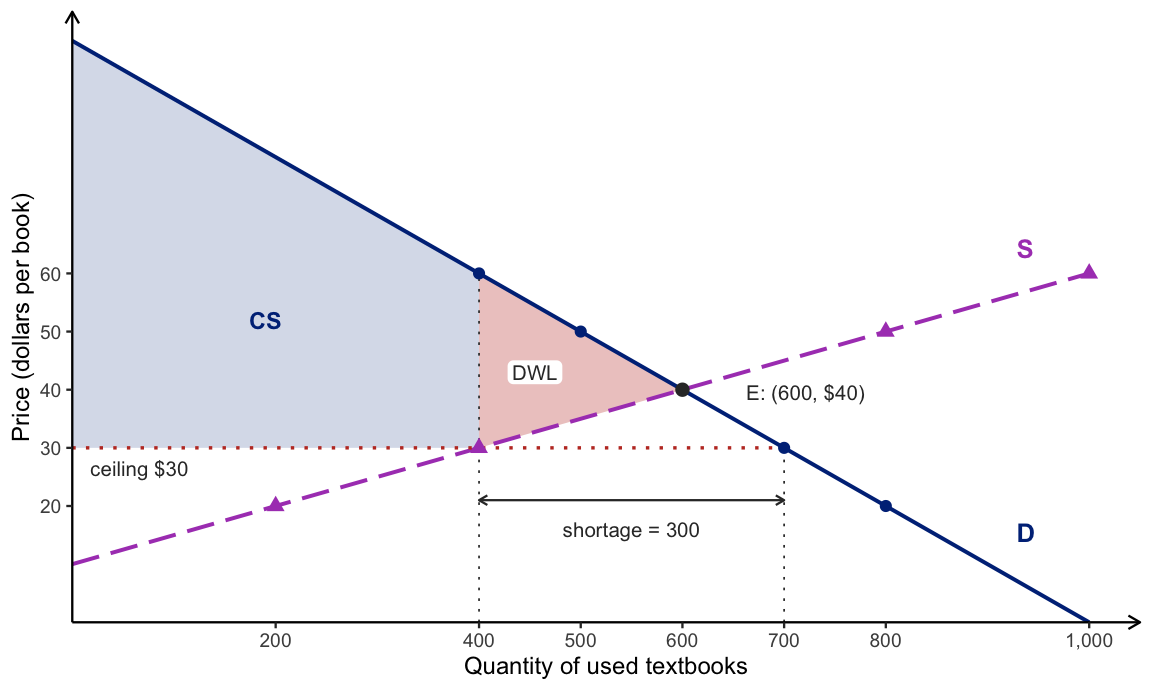
- On the axes below, draw and label the demand curve and the supply curve for used textbooks. Label the equilibrium price and the equilibrium quantity. [4 points]
Price belongs on the vertical axis and quantity of used textbooks on the horizontal axis. Demand slopes downward through the points \((800,20)\), \((700,30)\), \((600,40)\), \((500,50)\), \((400,60)\); supply slopes upward through \((200,20)\), \((400,30)\), \((600,40)\), \((800,50)\), \((1{,}000,60)\). The curves cross at the equilibrium price \(P^*=\$40\) and equilibrium quantity \(Q^*=600\) books.
- The university imposes a price ceiling of $30 per used textbook. Is this price ceiling binding? Draw it on your graph and compute the size of the resulting shortage or surplus. [3 points]
Yes, the ceiling is binding, because $30 lies below the equilibrium price of $40. It is drawn as a horizontal line at $30. At that price, quantity demanded is 700 books and quantity supplied is 400 books, so there is a shortage of 300 books.
- On your graph, shade and label the consumer surplus after the price ceiling is imposed and the deadweight loss. [3 points]
Only 400 books are traded under the ceiling. Consumer surplus is the area below the demand curve and above the $30 ceiling price, out to the 400 books actually traded rather than the 700 books demanded. The deadweight loss is the triangle bounded by the demand curve above, the supply curve below, and running from the restricted quantity of 400 books to the efficient quantity of 600 books.
- Name one group of buyers who is made better off by the price ceiling and one group who is made worse off. [2 points]
Buyers who still succeed in purchasing a used textbook are better off, because they pay $30 instead of $40, a saving of $10 per book. Buyers who bought a book at $40 before the ceiling but cannot find one now are worse off: 700 books are demanded at $30 but only 400 are supplied, fewer than the 600 that traded before. Sellers are worse off as well, since both price and quantity fall.
Part IV: Short Essay [8 points total]
Question 2: Elasticity and Tax Policy [8 points]
After class, a friend suggests that taxing groceries would be a good way for the government to raise revenue, because the demand for food is quite inelastic. In what sense is taxing groceries a good way to raise revenue? In what sense is it not a good way to raise revenue? In your answer, discuss both the efficiency consequences of the tax and who bears its burden.
Why it is a good way to raise revenue [4 points]. Because demand for food is inelastic, buyers do not reduce the quantity purchased much when the after-tax price rises. Two consequences follow. First, tax revenue is large and stable: revenue equals the tax per unit times the quantity traded, and the quantity barely falls. Second, the deadweight loss is small, because the deadweight loss triangle depends on the reduction in quantity traded, and few mutually beneficial trades are actually prevented. On efficiency grounds alone, inelastically demanded goods are exactly the goods a government would want to tax, because they raise revenue with the least deadweight loss.
Why it is not a good way to raise revenue [4 points]. The very inelasticity that makes the tax efficient also determines who pays it. The burden of a tax falls mainly on the less elastic side of the market, so buyers of food bear most of the tax, while sellers pass most of it through in higher prices. Food is a necessity, and low-income households spend a much larger share of their income on it than high-income households do, so the tax is regressive: it takes a larger percentage of income from those least able to pay. This is the efficiency versus equality tradeoff. The grocery tax scores well on the size of the economic pie and poorly on how the pie is divided, and equity is a legitimate goal of tax policy alongside efficiency.