ECON 110: Introductory Economics
Exam 1, Section 10, FALL 2026
This exam covers Chapters 1, 2, 3, 4, 5, 6, 7, and 8. It is worth 70 points.
Instructions
- This exam consists of 10 true or false questions, 15 multiple choice questions, 1 graphing question, and 1 short essay question.
- You will have a maximum of 60 minutes to complete this exam. No additional time may be taken without prior accommodation.
- Show all work to receive full credit.
- Calculators are permitted.
- For questions requiring computation, express your final answer with 2 decimal places.
- Every graph you draw must have both axes labeled and every curve labeled.
- Scratch paper is provided at the end of this exam. If you plan to use this extra page for your final answers, please write your name and student ID at the top so it is not lost.
Name:
Student ID:
Part I: True or False [2 points each, 20 points total]
Circle T if the statement is true and F if the statement is false. You do not need to explain your answer.
TF 1
T / F Choosing not to attend a music festival so that you can study for your economics exam is an example of a tradeoff.
TF 2
T / F A rational decision maker takes an action if and only if the marginal cost of that action exceeds the marginal benefit.
TF 3
T / F Positive statements are descriptive, while normative statements are prescriptive.
TF 4
T / F An economy producing at a point inside its production possibilities frontier is producing efficiently.
TF 5
T / F If one producer has the absolute advantage in the production of all goods, then that same producer will have the comparative advantage in the production of all goods as well.
TF 6
T / F An increase in the price of pizza will shift the demand curve for pizza to the left.
TF 7
T / F Goods with close substitutes tend to have more elastic demands than do goods without close substitutes.
TF 8
T / F A price ceiling set below the equilibrium price causes quantity demanded to exceed quantity supplied.
TF 9
T / F If the government imposes a binding price floor in a market, then consumer surplus in that market will increase.
TF 10
T / F As the price elasticities of supply and demand increase, the deadweight loss from a tax increases.
Part II: Multiple Choice [2 points each, 30 points total]
Circle the single best answer for each question. You do not need to explain your answer.
MC 1
You are planning your day off. You want to visit a popular art exhibit and you also want to attend a live concert, but the concert runs during exactly the hours the exhibit is open. Because you cannot be in two places at once, you have to pick just one. This situation illustrates the basic principle that
people respond to incentives.
rational people think at the margin.
people face tradeoffs.
improvements in efficiency sometimes come at the expense of equality.
MC 2
The phenomenon of scarcity stems from the fact that
most economies’ production methods are not very good.
in most economies, wealthy people consume disproportionate quantities of goods and services.
governments restrict production of too many goods and services.
resources are limited.
MC 3
Which of the following is a normative statement?
An increase in the minimum wage raises unemployment among young workers.
A tax on gasoline reduces the quantity of gasoline consumed.
The government should raise the federal minimum wage to $20 per hour.
Rent control leads to a shortage of apartments.
MC 4
In the circular-flow diagram, in the markets for
goods and services, households and firms are both sellers.
goods and services, households are buyers and firms are sellers.
the factors of production, households are buyers and firms are sellers.
the factors of production, households and firms are both buyers.
MC 5
Malik spends 30 hours per week preparing slide decks for group projects and studying for exams. One axis of Malik’s production possibilities frontier measures slide decks prepared per week; the other measures study sessions completed per week. Malik’s production possibilities frontier is a straight line if
Malik faces no tradeoff between preparing slide decks and studying for exams.
Malik can switch between the two tasks at a constant rate.
the rate at which Malik can switch between the two tasks depends on how much time he has already spent on each.
Malik is required to divide his time equally between preparing slide decks and studying.
MC 6
Jordan and Priya both enjoy specialty coffee and unique streetwear. The gains from trade between Jordan and Priya are most clear in which of the following situations?
Jordan is highly skilled at brewing specialty coffee and at designing custom streetwear, but Priya struggles with both tasks.
Jordan and Priya are both excellent at brewing coffee, but neither knows how to design or produce clothing.
Jordan and Priya both have very limited skills in making coffee and in designing streetwear.
Jordan excels at designing unique streetwear, and Priya is a master at brewing specialty coffee.
MC 7
Which of the following would shift the demand curve for gasoline to the right?
A decrease in the price of gasoline
An increase in consumer income, assuming gasoline is a normal good
An increase in the price of cars, a complement for gasoline
A decrease in the expected future price of gasoline
MC 8
Suppose that a decrease in the price of good \(X\) results in fewer units of good \(Y\) being demanded. This implies that \(X\) and \(Y\) are
complementary goods.
normal goods.
inferior goods.
substitute goods.
MC 9
Which of the following changes would not shift the supply curve for a good or service?
A change in production technology
A change in the price of the good or service
A change in expectations about the future price of the good or service
A change in input prices
MC 10
Suppose the price of a bag of frozen chicken nuggets decreases from $6.50 to $5.75 and, as a result, the quantity of bags demanded increases from 600 to 800. Using the midpoint method, \(\%\Delta X=(X_2-X_1)/((X_1+X_2)/2)\), the price elasticity of demand for frozen chicken nuggets in the given price range is
0.35.
0.43.
2.33.
2.89.
MC 11
Which of the following is likely to have the most price elastic demand?
Electronics
Smartphones
Google Pixel phones
Laptops
MC 12
Suppose the equilibrium price of a physical examination by a doctor is $200, and the government imposes a price ceiling of $150 per examination. As a result of the price ceiling, the
demand curve for physical examinations shifts to the right.
supply curve for physical examinations shifts to the left.
quantity demanded of physical examinations increases, and the quantity supplied of physical examinations decreases.
number of physical examinations performed stays the same.
MC 13
A per-unit tax is imposed on a market in which demand is more price elastic than supply. The larger share of the tax burden will fall on
buyers, because they are more responsive to price changes.
sellers, because they are less responsive to price changes.
buyers, because the tax is collected from them.
buyers and sellers equally, regardless of elasticity.
MC 14
Grant buys a popular ebook for $12, and his consumer surplus from the purchase is $3. How much is Grant willing to pay for the ebook?
$3
$9
$12
$15
MC 15
Suppose a tax of $5 per unit is imposed on a good, and the tax causes the equilibrium quantity of the good to decrease from 200 units to 100 units. The tax decreases consumer surplus by $450 and decreases producer surplus by $300. The deadweight loss from the tax is
$250.
$500.
$750.
$1,000.
Part III: Graphing [12 points total]
Question 1: A Market with a Price Ceiling [12 points]
The table below gives the monthly demand and supply schedules for used textbooks at a large university.
| Price (dollars per book) | Quantity demanded (books) | Quantity supplied (books) |
|---|---|---|
| 20 | 800 | 200 |
| 30 | 700 | 400 |
| 40 | 600 | 600 |
| 50 | 500 | 800 |
| 60 | 400 | 1,000 |
- On the axes below, draw and label the demand curve and the supply curve for used textbooks. Label the equilibrium price and the equilibrium quantity. [4 points]
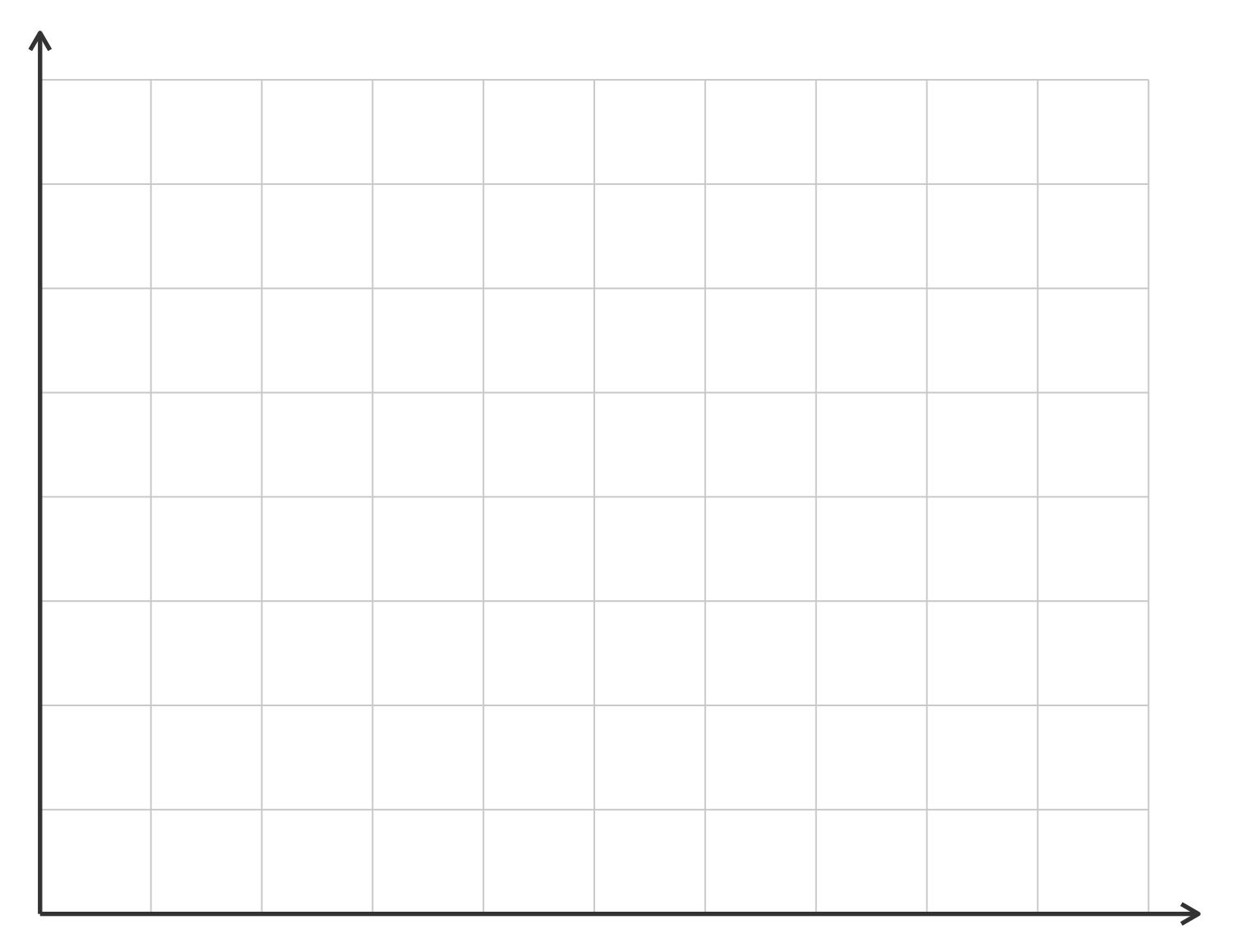
- The university imposes a price ceiling of $30 per used textbook. Is this price ceiling binding? Draw it on your graph and compute the size of the resulting shortage or surplus. [3 points]
On your graph, shade and label the consumer surplus after the price ceiling is imposed and the deadweight loss. [3 points]
Name one group of buyers who is made better off by the price ceiling and one group who is made worse off. [2 points]
Part IV: Short Essay [8 points total]
Question 2: Elasticity and Tax Policy [8 points]
After class, a friend suggests that taxing groceries would be a good way for the government to raise revenue, because the demand for food is quite inelastic. In what sense is taxing groceries a good way to raise revenue? In what sense is it not a good way to raise revenue? In your answer, discuss both the efficiency consequences of the tax and who bears its burden.
END OF EXAM
Scratch Paper
The printed exam ends with one full sheet of scratch paper, blank on both sides. You may remove this sheet and discard it after the exam. If you use it for any of your final answers, write your name and student ID at the top of the page so that it is not lost.