ECON 110: Introductory Economics
Exam 1, Section 11, FALL 2026 – Answer Key
This exam covers Chapters 1, 2, 3, 4, 5, 6, 7, and 8. It is worth 70 points.
Complete answer required for full credit.
Part I: True or False [2 points each, 20 points total]
TF 1
With careful planning, we can usually get something that we like without having to give up something else that we like.
FALSE. Scarcity means that getting one thing we like almost always requires giving up something else we like. Planning changes what we give up, not whether we give something up.
TF 2
Equality refers to how the pie is divided, and efficiency refers to the size of the economic pie.
TRUE. Efficiency concerns the size of the economic pie; equality concerns how that pie is distributed among members of society.
TF 3
Normative statements describe how the world is, while positive statements prescribe how the world should be.
FALSE. The definitions are reversed. Positive statements are descriptive; normative statements are prescriptive.
TF 4
Points outside the production possibilities frontier represent unattainable levels of production.
TRUE. The frontier marks the limit of what the economy can produce with its available factors of production and technology. Points on or inside the frontier are attainable.
TF 5
Two countries can achieve gains from trade even if one country has an absolute advantage in the production of both goods.
TRUE. Gains from trade follow from differences in opportunity cost, not from absolute advantage.
TF 6
A movement upward and to the left along a given demand curve is called a decrease in demand.
FALSE. That is a decrease in quantity demanded. A decrease in demand is a leftward shift of the entire curve.
TF 7
The demand for gasoline will respond more to a change in price over a period of five weeks than over a period of five years.
FALSE. Demand is more elastic over longer horizons, because buyers have time to buy more fuel-efficient cars, move closer to work, or switch to transit.
TF 8
A price floor set above the equilibrium price causes quantity supplied to exceed quantity demanded.
TRUE. A binding floor holds the price above equilibrium, which raises quantity supplied and lowers quantity demanded, creating a surplus.
TF 9
If Sakura is willing to pay $800 for concert tickets and has consumer surplus of $300, the price of the tickets is $500.
TRUE. Consumer surplus equals willingness to pay minus price, so the price is \(\$800-\$300=\$500\).
TF 10
The more inelastic are demand and supply, the greater is the deadweight loss of a tax.
FALSE. The relationship runs the other way. More inelastic curves mean the tax changes quantity less, so fewer mutually beneficial trades are prevented and the deadweight loss is smaller.
Part II: Multiple Choice [2 points each, 30 points total]
MC 1
While pollution regulations yield the benefit of a cleaner environment and the improved health that comes with it, the regulations come at the cost of reducing the incomes of the regulated firms’ owners, workers, and customers. This statement illustrates the principle that
trade can make everyone better off.
rational people think at the margin.
people face tradeoffs.
people respond to incentives.
A cleaner environment comes only at the cost of lower incomes, so society gives up one thing it values to get another.
MC 2
A rational decision maker takes an action if and only if the
total benefit of the action exceeds its total cost.
marginal benefit of the action exceeds its marginal cost.
average benefit of the action exceeds its average cost.
marginal cost of the action exceeds its marginal benefit.
Rational people think at the margin: an action is worth taking only if the additional benefit it brings exceeds the additional cost.
MC 3
Which of the following is a positive statement?
The government ought to provide health insurance to every citizen.
A rise in the tax on cigarettes reduces the number of cigarettes smoked.
Income inequality in the United States is too large.
Congress should reduce the federal budget deficit.
Only option (b) makes a claim about how the world is, which can be confirmed or refuted with data.
MC 4
In the circular-flow diagram, which of the following items flows from households to firms through the markets for goods and services?
Goods and services
Dollars paid to land, labor, and capital
Wages, rent, and profit
Dollars spent on goods and services
Households spend dollars on goods and services, and those dollars flow to firms as revenue. The goods and services themselves flow the other way, from firms to households.
MC 5
Suppose the United States can produce 5 smart TVs per hour of labor and China can produce 3 smart TVs per hour of labor. Does it necessarily follow that the United States should specialize in producing smart TVs?
Yes, because the United States has an absolute advantage in producing smart TVs.
Yes, because the United States can produce smart TVs at a lower opportunity cost.
No, because absolute advantage alone does not determine which good a country should produce.
No, because a country should always produce every good that it consumes.
Producing more TVs per hour is an absolute advantage, but specialization depends on comparative advantage. Option (b) does not follow because we cannot compute opportunity cost without knowing how much of some other good each country gives up to produce a TV.
MC 6
Trade between two countries can benefit both countries if each country
has an absolute advantage in the production of some good.
exports the goods for which it has a comparative advantage.
produces every good that it consumes.
has a lower opportunity cost in the production of every good.
Trade benefits both countries when each specializes in the good it produces at the lower opportunity cost. No country can have the lower opportunity cost in every good, which rules out option (d).
MC 7
You currently purchase seven instant noodle cups per week. You will graduate from college in December and begin a full-time job in January, and you have no plans to purchase instant noodles in January. For you, instant noodles are
a substitute good.
a normal good.
an inferior good.
a complementary good.
Demand falls when income rises, which is the definition of an inferior good.
MC 8
If bus rides and ride-share services are substitutes, a higher price for ride-share services would result in
an increase in the demand for ride-share services.
a decrease in the demand for ride-share services.
an increase in the demand for bus rides.
a decrease in the demand for bus rides.
A higher ride-share price leads some riders to switch to the bus, so the demand for bus rides shifts right. For ride-share services themselves, a change in their own price is a movement along the demand curve, which rules out (a) and (b).
MC 9
Workers at a plant that assembles electric scooters currently earn the mandatory minimum wage. If the federal government increases the minimum wage by $2.00 per hour, then it is likely that the
demand for electric scooter assembly workers will increase.
supply of electric scooters will shift to the right.
supply of electric scooters will shift to the left.
firm must increase output to maintain profit levels.
Wages are an input price; a higher input price shifts supply left.
MC 10
When the price of candy bars is $1.00, the quantity demanded is 500 per day. When the price falls to $0.80, the quantity demanded increases to 600 per day. Given this information and using the midpoint method, \(\%\Delta X=(X_2-X_1)/((X_1+X_2)/2)\), we know that the demand for candy bars is
inelastic.
elastic.
unit elastic.
perfectly inelastic.
The percentage change in quantity is \(100/550=18.18\%\) and the percentage change in price is \(-0.20/0.90=-22.22\%\), so the elasticity is \(18.18/22.22=0.82<1\).
MC 11
Which of the following is likely to have the most price inelastic demand?
Over-the-counter pain relievers
Pain relievers
A well-known brand of ibuprofen
A generic brand of ibuprofen
The most broadly defined market has the fewest substitutes and therefore the most inelastic demand.
MC 12
Suppose the equilibrium price of a tube of toothpaste is $2, and the government imposes a price floor of $3 per tube. As a result of the price floor, the
demand curve for toothpaste shifts to the left.
supply curve for toothpaste shifts to the right.
quantity supplied of toothpaste stays the same.
quantity demanded of toothpaste decreases, and the quantity of toothpaste that firms want to supply increases.
A price floor does not shift either curve. At the higher price, buyers want less toothpaste and firms want to sell more, creating a surplus.
MC 13
A per-unit tax is imposed on a market in which supply is more price elastic than demand. The larger share of the tax burden will fall on
buyers, because they are less responsive to price changes.
sellers, because they are more responsive to price changes.
sellers, because the tax is collected from them.
buyers and sellers equally, regardless of elasticity.
The burden of a tax falls more heavily on the less elastic side of the market, which here is buyers. Which side the tax is collected from does not change who bears it.
MC 14
Emma Claire values a smart thermostat for her new house at $350, but she succeeds in buying one for $275. Emma Claire’s consumer surplus from this purchase is
$75.
$275.
$350.
$625.
Consumer surplus equals willingness to pay minus price: \(\$350-\$275=\$75\).
MC 15
A tax of $15 per unit is imposed on a good, causing the equilibrium quantity in the market to decrease by 300 units. The supply curve is the typical upward-sloping straight line and the demand curve is the typical downward-sloping straight line. The deadweight loss from the tax is
$1,750.
$2,250.
$3,000.
$4,500.
The deadweight loss is a triangle with height equal to the tax and base equal to the change in quantity: \(\tfrac12\times\$15\times300=\$2{,}250\).
Part III: Graphing [12 points total]
Question 1: A Market with a Price Floor [12 points]
| Price (dollars per fridge) | Quantity demanded (fridges) | Quantity supplied (fridges) |
|---|---|---|
| 40 | 900 | 300 |
| 50 | 800 | 500 |
| 60 | 700 | 700 |
| 70 | 600 | 900 |
| 80 | 500 | 1,100 |
- On the axes below, draw and label the demand curve and the supply curve for mini-fridges. Label the equilibrium price and the equilibrium quantity. [4 points]
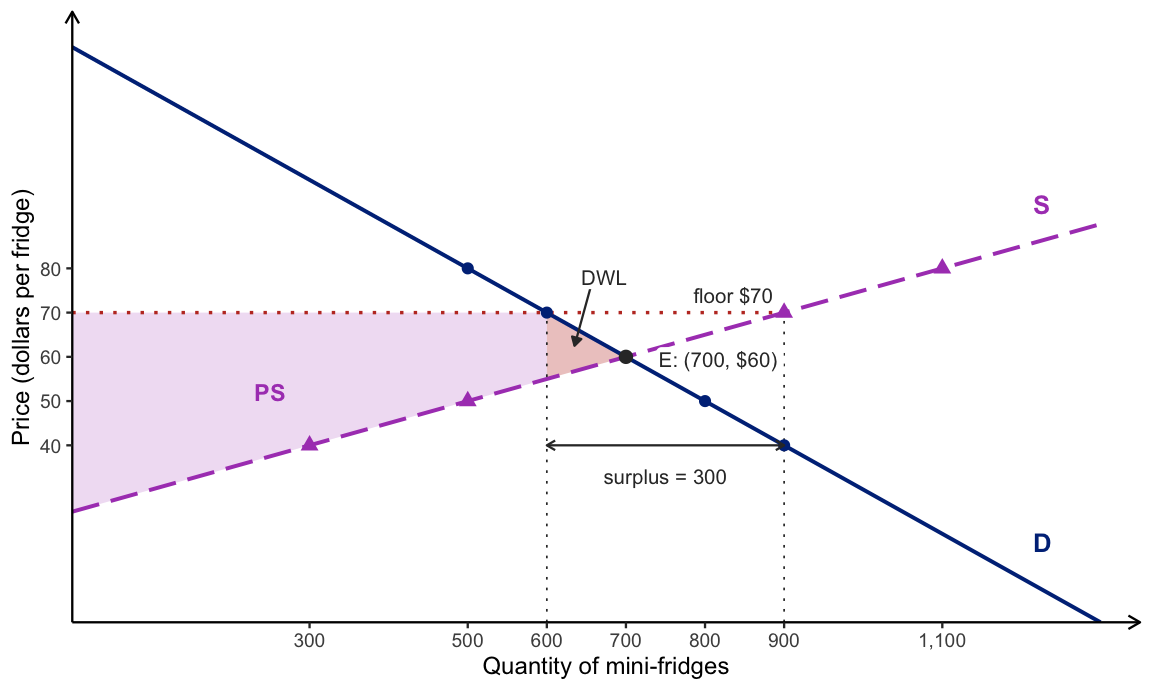
Price belongs on the vertical axis and quantity of mini-fridges on the horizontal axis. Demand slopes downward through \((900,40)\), \((800,50)\), \((700,60)\), \((600,70)\), \((500,80)\); supply slopes upward through \((300,40)\), \((500,50)\), \((700,60)\), \((900,70)\), \((1{,}100,80)\). The curves cross at the equilibrium price \(P^*=\$60\) and equilibrium quantity \(Q^*=700\) fridges.
- The city imposes a price floor of $70 per mini-fridge. Is this price floor binding? Draw it on your graph and compute the size of the resulting shortage or surplus. [3 points]
Yes, the floor is binding, because $70 lies above the equilibrium price of $60. It is drawn as a horizontal line at $70. At that price, quantity supplied is 900 fridges and quantity demanded is 600 fridges, so there is a surplus of 300 fridges.
- On your graph, shade and label the producer surplus after the price floor is imposed and the deadweight loss. [3 points]
Only 600 fridges are traded under the floor, because quantity traded is set by the short side of the market. Producer surplus is the area above the supply curve and below the $70 floor price, out to the 600 fridges actually traded rather than the 900 fridges supplied. The deadweight loss is the triangle bounded by the demand curve above, the supply curve below, and running from the restricted quantity of 600 fridges to the efficient quantity of 700 fridges.
- Name one group of sellers who is made better off by the price floor and one group who is made worse off. [2 points]
Sellers who still succeed in selling a fridge are better off, because they receive $70 instead of $60, a gain of $10 per fridge. Sellers who sold a fridge at $60 before the floor but cannot find a buyer now are worse off: 900 fridges are offered at $70 but only 600 are bought, fewer than the 700 that traded before. Buyers are worse off as well, since they pay more and buy less.
Part IV: Short Essay [8 points total]
Question 2: Elasticity and Tax Policy [8 points]
After class, a friend suggests that raising the gasoline tax would be a good way for the government to raise revenue, because the demand for gasoline is quite inelastic in the short run. In what sense is taxing gasoline a good way to raise revenue? In what sense is it not a good way to raise revenue? In your answer, discuss the efficiency consequences of the tax, who bears its burden, and how your answer changes as the time horizon lengthens.
Why it is a good way to raise revenue [3 points]. Because short-run demand for gasoline is inelastic, drivers do not reduce the quantity purchased much when the after-tax price rises. Revenue equals the tax per gallon times the quantity sold, and quantity barely falls, so revenue is large and predictable. For the same reason the deadweight loss is small: the deadweight loss triangle depends on the reduction in quantity traded, and few mutually beneficial trades are actually prevented.
Why it is not a good way to raise revenue [3 points]. The burden of a tax falls mainly on the less elastic side of the market, so drivers bear most of the tax, while sellers pass most of it through in higher prices. Gasoline is close to a necessity for households that must commute, and low-income and rural households spend a much larger share of their income on fuel than high-income urban households do. The tax is therefore regressive, which is the efficiency versus equality tradeoff: the policy scores well on the size of the economic pie and poorly on how the pie is divided.
How the time horizon matters [2 points]. Demand is far more elastic in the long run than in the short run. Over several years drivers can buy more fuel-efficient vehicles, switch to electric vehicles or transit, carpool, or move closer to work. As demand becomes more elastic, the quantity of gasoline sold falls by more, so the deadweight loss of the tax grows and the revenue it raises shrinks. The short-run case for the tax as a revenue source is therefore stronger than the long-run case.