ECON 110: Introductory Economics
Exam 2, Section 10, FALL 2026 – Answer Key
This exam covers Chapters 10, 11, 14, 15, and 16. It is worth 70 points.
Complete answer required for full credit.
Part I: True or False [2 points each, 20 points total]
TF 1
When market activity generates a negative externality, the level of output in the market equilibrium is lower than the socially optimal level.
FALSE. With a negative externality the social cost exceeds the private cost, so the market produces more than the socially optimal quantity.
TF 2
A congestion toll imposed on a highway driver to force the driver to take into account the increase in travel time she imposes on all other drivers is an example of internalizing the externality.
TRUE. Internalizing an externality means altering incentives so that decision makers face the full social cost of their actions, which is exactly what the toll does.
TF 3
One person’s use of a common resource does not reduce the enjoyment other people receive from that resource.
FALSE. Common resources are rival in consumption: one person’s use does diminish what is available to others. That rivalry is the source of the Tragedy of the Commons.
TF 4
One possible solution to the problem of protecting a common resource is to convert that resource to a private good.
TRUE. Establishing property rights makes the resource excludable, so the owner internalizes the cost of overuse.
TF 5
If a firm produces nothing, it still incurs its fixed costs.
TRUE. Fixed costs do not vary with the quantity produced, so they are incurred even at zero output.
TF 6
When average total cost is above marginal cost, average total cost is rising.
FALSE. When marginal cost is below average total cost, each additional unit pulls the average down, so average total cost is falling.
TF 7
A firm will shut down in the short run if revenue is not sufficient to cover its variable costs of production.
TRUE. Fixed costs are sunk in the short run, so the relevant comparison is price against average variable cost.
TF 8
For a firm operating in a perfectly competitive industry, total revenue, marginal revenue, and average revenue are all equal.
FALSE. Marginal revenue and average revenue both equal the price, but total revenue equals price times quantity, which exceeds the price whenever the firm sells more than one unit.
TF 9
The fundamental cause of monopoly is barriers to entry.
TRUE. A firm remains the sole seller only if something prevents rivals from entering: resource ownership, government-created barriers such as patents, or a natural-monopoly cost structure.
TF 10
A monopolist earns higher profits by charging a single price than by practicing price discrimination.
FALSE. Price discrimination allows the monopolist to capture surplus from buyers with high willingness to pay while still serving buyers with low willingness to pay, which raises profit.
Part II: Multiple Choice [2 points each, 30 points total]
MC 1
When negative externalities are present in a market,
private costs will be greater than social costs.
social costs will be greater than private costs.
only government regulation will solve the problem.
the market will not be able to generate an equilibrium.
A negative externality is a cost borne by bystanders, so the social cost equals the private cost plus that external cost.
MC 2
Suppose that plastic packaging creates a negative externality equal to $2 per unit due to environmental damage. What is the relationship between the equilibrium quantity of plastic packaging and the socially optimal quantity?
They are equal.
The equilibrium quantity is greater than the socially optimal quantity.
The equilibrium quantity is less than the socially optimal quantity.
There is not enough information to answer the question.
Producers ignore the $2 external cost, so the supply curve lies below the social cost curve and the market produces more than the socially optimal quantity.
MC 3
Which of the following statements is not correct?
Government policies may improve the market’s allocation of resources when negative externalities are present.
Government policies may improve the market’s allocation of resources when positive externalities are present.
A positive externality is an example of a market failure.
Without government intervention, the market will tend to undersupply products that produce negative externalities.
Markets oversupply goods that generate negative externalities.
MC 4
Goods that are rival in consumption but not excludable would be considered
common resources.
club goods.
public goods.
private goods.
A common resource is rival in consumption but not excludable. A club good is the reverse: excludable but not rival.
MC 5
Both public goods and common resources are
rival in consumption.
nonrival in consumption.
excludable.
nonexcludable.
No one can be prevented from using either a public good or a common resource. The two differ in rivalry: common resources are rival in consumption and public goods are not.
MC 6
A city street is
always a public good, whether or not it is congested.
a public good when it is congested, but a common resource when it is not congested.
a common resource when it is congested, but a public good when it is not congested.
always a common resource, whether or not it is congested.
Congestion is what makes the street rival in consumption.
MC 7
Bubba is a shrimp fisherman who could earn $5,000 as a fishing tour guide. Instead, he is a full-time shrimp fisherman. In calculating the economic profit of his shrimp business, the $5,000 that Bubba gave up is counted as part of the shrimp business’s
total revenue.
explicit costs.
implicit costs.
marginal costs.
The $5,000 Bubba gives up is an opportunity cost that requires no outlay of money, which makes it an implicit cost.
MC 8
Chloe’s Car Wash has average variable costs of $2 and average fixed costs of $3 when it produces 100 car washes. The firm’s total cost is
$100.
$200.
$300.
$500.
Average total cost is \(\$2+\$3=\$5\), so total cost is \(\$5\times100=\$500\).
MC 9
Suppose that for a particular firm the only variable input into the production process is labor, and that output equals zero when no workers are hired. Suppose further that the average total cost when 5 units of output are produced is $30, and the marginal cost of the sixth unit of output is $60. What is the average total cost when 6 units are produced?
$10
$25
$30
$35
Total cost at 5 units is \(5\times\$30=\$150\); adding the sixth unit gives \(\$150+\$60=\$210\), so average total cost is \(\$210/6=\$35\).
MC 10
If a firm in a perfectly competitive market triples the quantity of output sold, then total revenue will
more than triple.
less than triple.
exactly triple.
be reduced by one third.
The firm is a price taker, so total revenue is proportional to quantity.
MC 11
Suppose a firm in a competitive market earned $1,000 in total revenue and had a marginal revenue of $10 for the last unit produced and sold. What is the average revenue per unit, and how many units were sold?
$5 and 50 units
$5 and 100 units
$10 and 50 units
$10 and 100 units
For a competitive firm marginal revenue equals average revenue equals price, so average revenue is $10 and quantity is \(\$1{,}000/\$10=100\) units.
MC 12
Whenever a perfectly competitive firm chooses to change its level of output, its marginal revenue
increases if marginal revenue is below average total cost and decreases if marginal revenue is above average total cost.
does not change.
always increases.
always decreases.
A competitive firm is a price taker, so its marginal revenue equals the market price at every quantity.
MC 13
A natural monopoly occurs when
there are economies of scale over the relevant range of output.
the product is sold in its natural state, such as water or diamonds.
the firm is characterized by a rising marginal cost curve.
production requires the use of free natural resources, such as water or air.
With economies of scale over the relevant range, a single firm can supply the whole market at a lower average total cost than two or more firms could.
MC 14
Which of the following is not an example of a barrier to entry?
A mining company owns a unique plot of land in Tanzania, under which lies the only large deposit of tanzanite in the world.
A pharmaceutical company obtains a patent for a specific high blood pressure medication.
A musician obtains a copyright for an original song.
An entrepreneur opens a popular new restaurant.
Nothing prevents competitors from opening similar restaurants.
MC 15
Suppose most people regard emeralds, rubies, and sapphires as close substitutes for diamonds. Then DeBeers, a large diamond company, has
less incentive to advertise than it would otherwise have.
less market power than it would otherwise have.
more control over the price of diamonds than it would otherwise have.
higher profits than it would otherwise have.
Close substitutes make the demand for diamonds more elastic, which limits how far DeBeers can raise its price above marginal cost.
Part III: Graphing [12 points total]
Question 1: Monopoly Pricing [12 points]
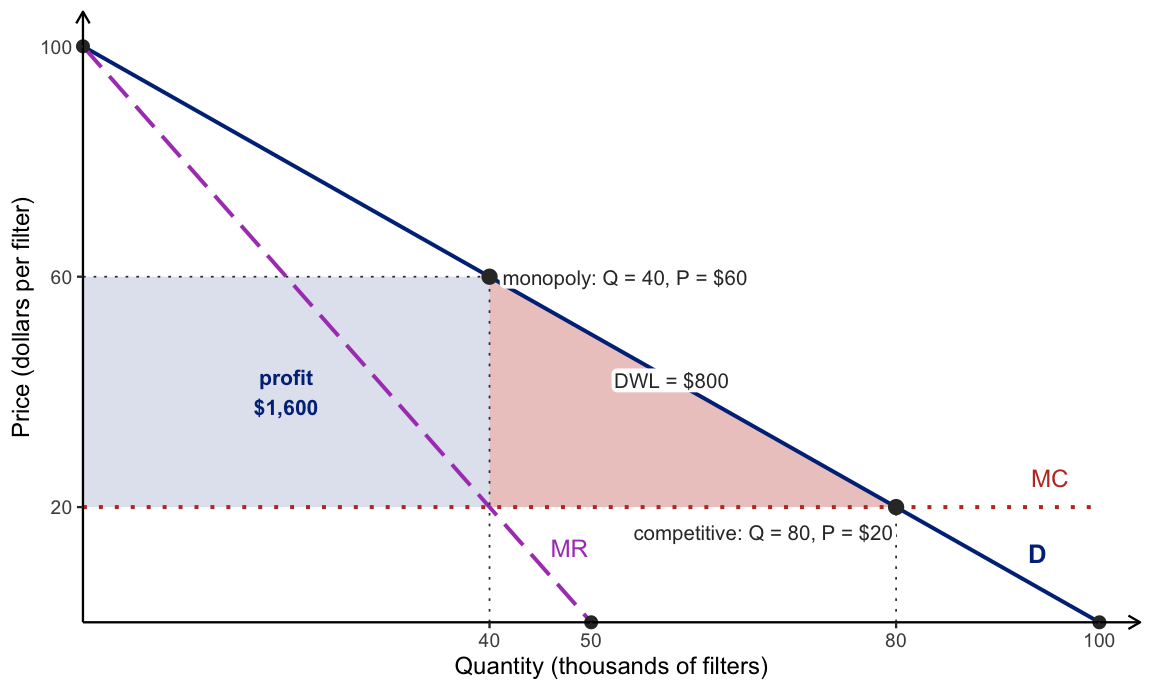
A monopolist is the sole producer of a patented water filter. The firm faces the demand curve \(P = 100 - Q\), where \(P\) is the price in dollars and \(Q\) is the quantity in thousands of units. Its marginal revenue curve is \(MR = 100 - 2Q\). The firm produces at a constant marginal cost of $20 per unit and has no fixed costs.
- On the axes below, draw and label the demand curve, the marginal revenue curve, and the marginal cost curve. [3 points]
Price on the vertical axis, quantity on the horizontal axis. Demand runs from a vertical intercept of $100 to a horizontal intercept of \(Q=100\). Marginal revenue shares the $100 vertical intercept but is twice as steep, hitting the horizontal axis at \(Q=50\). Marginal cost is a horizontal line at $20.
- Find the profit-maximizing quantity and the price the monopolist charges. Mark both on your graph. [3 points]
Set \(MR = MC\):
\[100 - 2Q = 20 \implies Q = 40.\]
The monopolist reads the price off the demand curve at that quantity: \(P = 100 - 40 = \mathbf{\$60}\), selling \(\mathbf{Q=40}\) thousand units.
- Compute the monopolist’s profit. [2 points]
With constant marginal cost of $20 and no fixed costs, average total cost is also $20. Profit is
\[(P - ATC)\times Q = (\$60 - \$20)\times 40 = \mathbf{\$1{,}600}\ \text{thousand}.\]
- What quantity and price would prevail if this market were instead perfectly competitive? [2 points]
A competitive market produces where price equals marginal cost: \(P = \mathbf{\$20}\), and \(20 = 100 - Q\) gives \(\mathbf{Q = 80}\) thousand units. The monopolist restricts output to half the competitive quantity and charges three times the competitive price.
- On your graph, shade and label the deadweight loss of the monopoly. Compute its area. [2 points]
The deadweight loss is the triangle bounded by the demand curve above, the marginal cost curve below, and running from the monopoly quantity of 40 to the competitive quantity of 80. Its height is \(\$60-\$20=\$40\) and its base is \(80-40=40\), so
\[DWL = \tfrac12\times\$40\times40 = \mathbf{\$800}\ \text{thousand}.\]
Part IV: Short Essay [8 points total]
Question 2: The Firm’s Shutdown Decision [8 points]
Cascade Cabinets operates in a perfectly competitive market. At its current output of 500 cabinets, the firm’s average total cost is $90 per cabinet, its average variable cost is $65 per cabinet, and the market price is $75 per cabinet.
- Is the firm earning a profit or a loss? Compute the amount. [3 points]
The firm is earning a loss. Total revenue is \(\$75\times500=\$37{,}500\) and total cost is \(\$90\times500=\$45{,}000\), so profit is
\[(P - ATC)\times Q = (\$75 - \$90)\times 500 = -\mathbf{\$7{,}500}.\]
- Should the firm shut down in the short run? Justify your answer with a comparison of the losses under each option. [3 points]
No, the firm should keep operating. The price of $75 exceeds average variable cost of $65, so every cabinet sold covers its own variable cost and contributes $10 toward fixed cost. Fixed cost is
\[(ATC - AVC)\times Q = (\$90 - \$65)\times 500 = \$12{,}500,\]
which the firm must pay whether or not it produces. Shutting down would therefore mean a loss of $12,500, which is worse than the $7,500 loss from continuing to operate. In the short run, a firm shuts down only when price falls below average variable cost.
- If this situation persists into the long run, what will the firm do, and what will happen to the market price? Explain. [2 points]
In the long run all costs are variable and the firm can escape its fixed cost by exiting. Since price of $75 is below average total cost of $90, the firm is not covering its full opportunity cost and will exit the market. Other firms earning the same economic loss will exit as well. As they leave, market supply shifts to the left and the market price rises. Exit continues until price has risen to the minimum of average total cost, at which point the remaining firms earn zero economic profit and there is no further incentive to enter or exit.