ECON 110: Introductory Economics
Exam 2, Section 11, FALL 2026 – Answer Key
This exam covers Chapters 10, 11, 14, 15, and 16. It is worth 70 points.
Complete answer required for full credit.
Part I: True or False [2 points each, 20 points total]
TF 1
A technology spillover is a type of negative externality.
FALSE. A technology spillover is a positive externality: one firm’s research benefits other firms that did not pay for it.
TF 2
When firms internalize a negative externality, the market supply curve shifts to the left.
TRUE. Internalizing raises the private cost of production to the social cost, which shifts supply up and to the left.
TF 3
The free-rider problem makes it unlikely that poverty will be entirely eliminated through private charity.
TRUE. Reducing poverty is nonexcludable: everyone who values a society with less poverty benefits whether or not they donate, so private giving falls short of the socially optimal amount.
TF 4
Aristotle writes, “What is common to many is taken least care of, for all men have greater regard for what is their own than for what they possess in common with others.” In this statement, Aristotle is referring to the free-rider problem.
FALSE. Aristotle is describing the Tragedy of the Commons, which concerns overuse of a rival but nonexcludable resource. The free-rider problem concerns underprovision of a nonrival, nonexcludable good.
TF 5
Variable costs equal fixed costs when nothing is produced.
FALSE. Variable cost is zero when nothing is produced, but fixed cost is still incurred. It is total cost that equals fixed cost at zero output.
TF 6
If the marginal cost of producing the tenth unit of output is $3, and if the average total cost of producing the tenth unit of output is $2, then at ten units of output average total cost is rising.
TRUE. Marginal cost of $3 exceeds average total cost of $2, so the additional unit pulls the average up.
TF 7
A firm operating in a competitive market will stay in business in the short run so long as the market price exceeds the firm’s average total cost; otherwise, the firm will shut down.
FALSE. The short-run shutdown rule compares price to average variable cost, not average total cost. Fixed costs are sunk in the short run.
TF 8
Firms operating in perfectly competitive markets produce the output level at which marginal revenue equals marginal cost.
TRUE. This is the general profit-maximizing rule. Since marginal revenue equals price for a competitive firm, the rule reduces to producing where price equals marginal cost.
TF 9
Copyrights and patents are examples of barriers to entry that give firms monopoly pricing power.
TRUE. These are government-created barriers that grant an exclusive right to produce and sell.
TF 10
Price discrimination is prohibited by antitrust laws.
FALSE. Price discrimination is legal and common. Student and senior discounts, airline fare classes, and quantity discounts are all everyday examples.
Part II: Multiple Choice [2 points each, 30 points total]
MC 1
When an externality is present, the market equilibrium is
efficient, and the equilibrium maximizes the total benefit to society as a whole.
efficient, but the equilibrium does not maximize the total benefit to society as a whole.
inefficient, but the equilibrium maximizes the total benefit to society as a whole.
inefficient, and the equilibrium does not maximize the total benefit to society as a whole.
An externality drives a wedge between private and social costs or benefits, so the market quantity differs from the quantity that maximizes total surplus.
MC 2
When Jordan flies a drone for recreational purposes in a public park, he unknowingly disturbs nearby pedestrians. In this case, the external cost of Jordan’s drone usage
increases the social cost above the private cost.
lowers the social cost below the private cost.
increases the social value above the private benefit.
decreases the social value below the private benefit.
The disturbance to pedestrians is a cost that Jordan does not bear, so the social cost of the drone use exceeds the private cost.
MC 3
Which of the following statements about urban rooftop gardens best conveys the general nature of the externality?
An urban rooftop garden conveys a positive externality because it improves the air quality of the building.
An urban rooftop garden conveys a negative externality because it increases maintenance costs for the building owner.
An urban rooftop garden conveys a positive externality because it increases the value of adjacent properties in the neighborhood.
An urban rooftop garden cannot provide any type of externality.
An externality falls on bystanders. Options (a) and (b) describe effects on the building owner, who is party to the decision.
MC 4
Goods that are excludable include both
club goods and public goods.
public goods and common resources.
common resources and private goods.
private goods and club goods.
A good is excludable when people can be prevented from using it. Private goods and club goods are excludable; public goods and common resources are not.
MC 5
The provision of a public good generates a
positive externality, as does the use of a common resource.
positive externality, and the use of a common resource generates a negative externality.
negative externality, as does the use of a common resource.
negative externality, and the use of a common resource generates a positive externality.
A public good benefits people who did not pay for it, which is a positive externality. Each person’s use of a common resource leaves less for everyone else, which is a negative externality.
MC 6
A publicly posted online video is an example of a good that is
private.
not rival in consumption.
social.
excludable.
One person watching the video does not reduce anyone else’s ability to watch it.
MC 7
If a firm produces nothing, which of the following costs will be zero?
Total cost
Fixed cost
Opportunity cost
Variable cost
Variable cost changes with output and is zero when nothing is produced. Fixed cost, and therefore total cost, is incurred even at zero output.
MC 8
Taylor’s Tent Company has total fixed costs of $300,000 per year. The firm’s average variable cost is $80 when it produces 10,000 tents. At that level of output, the firm’s average total cost equals
$80.
$90.
$100.
$110.
Average fixed cost is \(\$300{,}000/10{,}000=\$30\), so average total cost is \(\$30+\$80=\$110\).
MC 9
As Bubba’s Bubble Gum Company adds workers while using the same amount of machinery, some workers are underutilized because they have little to do while waiting in line to use the machinery. When this occurs, Bubba’s Bubble Gum Company encounters
economies of scale.
diseconomies of scale.
increasing marginal product.
diminishing marginal product.
Capital is held fixed while labor rises, which is the short-run setting in which marginal product diminishes. Economies and diseconomies of scale are long-run concepts in which all inputs vary.
MC 10
Suppose a firm in a competitive market produces and sells 150 units of output and earns $1,800 in total revenue from those sales. If the firm increases its output to 200 units, the average revenue of the 200th unit will be
less than $12.
more than $12.
$12.
zero.
Average revenue is \(\$1{,}800/150=\$12\), and a price taker faces the same price at every quantity.
MC 11
Which of the following statements is correct?
For all firms, marginal revenue equals the price of the good.
Only for competitive firms does average revenue equal the price of the good.
Marginal revenue can be calculated as total revenue divided by the quantity sold.
Only for competitive firms does average revenue equal marginal revenue.
Average revenue equals price for every firm, which rules out (b). Marginal revenue equals price only for a price taker, which rules out (a). Option (c) describes average revenue, not marginal revenue.
MC 12
A profit-maximizing firm in a perfectly competitive market chooses the quantity at which
average total cost is minimized.
total revenue is maximized.
price equals marginal cost.
price equals average variable cost.
Every firm maximizes profit where marginal revenue equals marginal cost, and a competitive firm’s marginal revenue is the market price.
MC 13
When an industry is a natural monopoly,
it is characterized by constant returns to scale.
it is characterized by diseconomies of scale.
a larger number of firms may lead to a lower average total cost.
a larger number of firms will lead to a higher average total cost.
Average total cost falls over the relevant range, so splitting output among several firms raises the cost of serving the market.
MC 14
Which of the following is a necessary characteristic of a monopoly?
The firm is the sole seller of its product.
The firm’s product has many close substitutes.
The firm generates a large economic profit.
The firm is located in a small geographic market.
A monopoly is the sole seller of a product without close substitutes. A large profit or a small market may accompany a monopoly, but neither is required.
MC 15
Granting a pharmaceutical company a patent for a new medicine will lead to
a product that is priced higher than it would be without the exclusive rights.
reduced incentives for pharmaceutical companies to invest in research and development.
lower quantities of output than would occur if the drug were never invented.
lower prices than without the patent.
The patent is the tradeoff at the heart of monopoly policy: it raises the price above marginal cost, but the prospect of that profit is what induced the firm to develop the drug at all.
Part III: Graphing [12 points total]
Question 1: Monopoly Pricing [12 points]
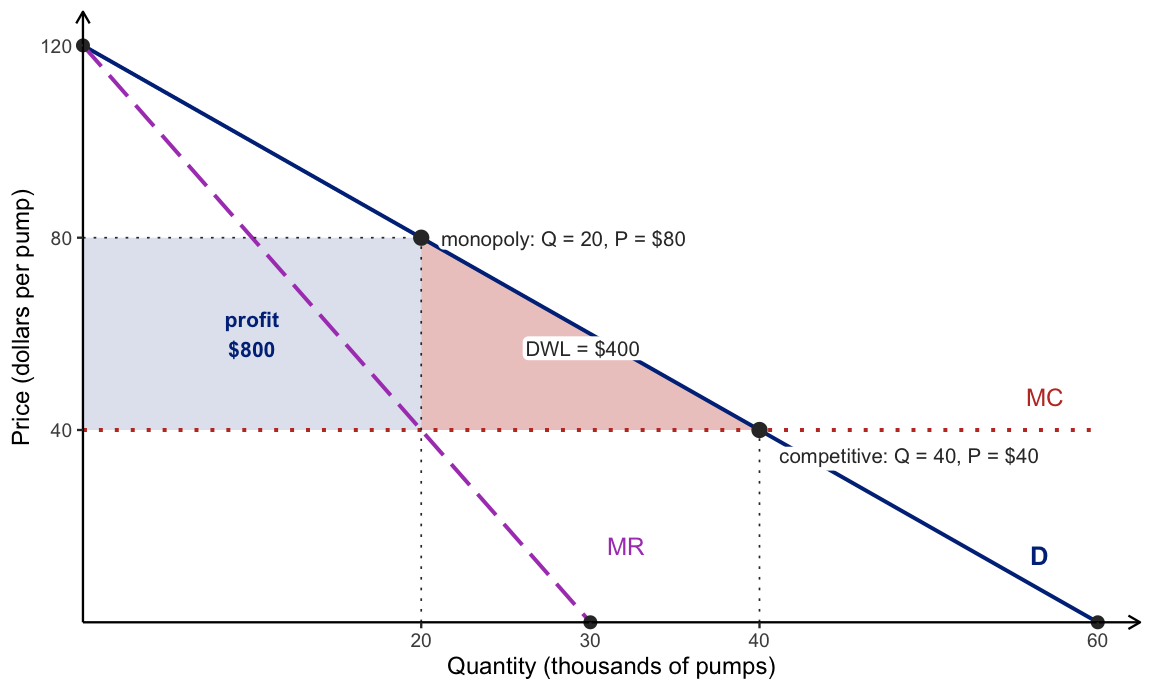
A monopolist is the sole producer of a patented insulin pump. The firm faces the demand curve \(P = 120 - 2Q\), where \(P\) is the price in dollars and \(Q\) is the quantity in thousands of units. Its marginal revenue curve is \(MR = 120 - 4Q\). The firm produces at a constant marginal cost of $40 per unit and has no fixed costs.
- On the axes below, draw and label the demand curve, the marginal revenue curve, and the marginal cost curve. [3 points]
Price on the vertical axis, quantity on the horizontal axis. Demand runs from a vertical intercept of $120 to a horizontal intercept of \(Q=60\). Marginal revenue shares the $120 vertical intercept but is twice as steep, hitting the horizontal axis at \(Q=30\). Marginal cost is a horizontal line at $40.
- Find the profit-maximizing quantity and the price the monopolist charges. Mark both on your graph. [3 points]
Set \(MR = MC\):
\[120 - 4Q = 40 \implies Q = 20.\]
The monopolist reads the price off the demand curve at that quantity: \(P = 120 - 2(20) = \mathbf{\$80}\), selling \(\mathbf{Q=20}\) thousand units.
- Compute the monopolist’s profit. [2 points]
With constant marginal cost of $40 and no fixed costs, average total cost is also $40. Profit is
\[(P - ATC)\times Q = (\$80 - \$40)\times 20 = \mathbf{\$800}\ \text{thousand}.\]
- What quantity and price would prevail if this market were instead perfectly competitive? [2 points]
A competitive market produces where price equals marginal cost: \(P = \mathbf{\$40}\), and \(40 = 120 - 2Q\) gives \(\mathbf{Q = 40}\) thousand units. The monopolist restricts output to half the competitive quantity and charges twice the competitive price.
- On your graph, shade and label the deadweight loss of the monopoly. Compute its area. [2 points]
The deadweight loss is the triangle bounded by the demand curve above, the marginal cost curve below, and running from the monopoly quantity of 20 to the competitive quantity of 40. Its height is \(\$80-\$40=\$40\) and its base is \(40-20=20\), so
\[DWL = \tfrac12\times\$40\times20 = \mathbf{\$400}\ \text{thousand}.\]
Part IV: Short Essay [8 points total]
Question 2: The Firm’s Shutdown Decision [8 points]
Bayview Bakery operates in a perfectly competitive market. At its current output of 800 loaves, the firm’s average total cost is $4.50 per loaf, its average variable cost is $3.25 per loaf, and the market price is $3.00 per loaf.
- Is the firm earning a profit or a loss? Compute the amount. [3 points]
The firm is earning a loss. Total revenue is \(\$3.00\times800=\$2{,}400\) and total cost is \(\$4.50\times800=\$3{,}600\), so profit is
\[(P - ATC)\times Q = (\$3.00 - \$4.50)\times 800 = -\mathbf{\$1{,}200}.\]
- Should the firm shut down in the short run? Justify your answer with a comparison of the losses under each option. [3 points]
Yes, the firm should shut down. The price of $3.00 is below average variable cost of $3.25, so every loaf sold fails to cover even its own variable cost. Fixed cost is
\[(ATC - AVC)\times Q = (\$4.50 - \$3.25)\times 800 = \$1{,}000,\]
which the firm must pay whether or not it produces. Shutting down therefore means a loss of $1,000, which is smaller than the $1,200 loss from continuing to operate, so the firm saves $200 by producing nothing in the short run.
- If this situation persists into the long run, what will the firm do, and what will happen to the market price? Explain. [2 points]
In the long run all costs are variable and the firm can escape its fixed cost by exiting. Since price of $3.00 is far below average total cost of $4.50, the firm is not covering its full opportunity cost and will exit the market. Other firms earning the same economic loss will exit as well. As they leave, market supply shifts to the left and the market price rises. Exit continues until price has risen to the minimum of average total cost, at which point the remaining firms earn zero economic profit and there is no further incentive to enter or exit.