ECON 672: Economics of Development
Week 10: Risk, insurance, and savings
Risk
de Janvry & Sadoulet on Risk and Self-Insurance
Farming is a highly risky business. Poor people are risk-averse because a negative shock can have devastating consequences for them, operating as they are at the margin of survival. At the same time, formal insurance is generally not available to these households. The combination of risk, risk aversion, and insurance market failures implies that farm households must devise self-insurance strategies to reduce their income and consumption risks. […] For the household, the objective is to smooth consumption so it meets its consumption needs in both good and bad years.
— de Janvry & Sadoulet, p. 270
Risk Management: Income Strategies and Savings
Risk management: reducing income risks given exposure
Income strategies:
- Crop diversification
- Plant less risky traditional seeds
- Portfolio of other economic activities
Precautionary savings; savings as insurance:
- Productive, liquid asset savings (livestock)
- Productive, illiquid asset savings (“brick by brick”)
Risk Management: Contracts and Insurance
Contract design:
- Sharecropping to spread risk
- Forward-sales contracts
Insurance:
- Formal, index-based weather insurance
- Group, mutual insurance for idiosyncratic shocks
de Janvry & Sadoulet on Risk Sharing
With perfect risk sharing, consumption at the household level should be insured against idiosyncratic risks and thus depend solely on the realization of community-level aggregate risk. Townsend (1994) tests this implication of perfect intra-village risk sharing using household panel data on consumption and income for three villages in India. He finds that the full-insurance hypothesis provides a good benchmark in that households’ consumption levels move up and down together and do not appear to be much influenced by contemporaneous own income.
— de Janvry & Sadoulet, pp. 270–271
Testing for Full Risk Sharing
Following Townsend (1994), we test full risk sharing within group \(g\) using the first moment (mean) and second moment (variance) of household consumption: \[c_{igt} = \alpha_i + \beta_1\, y_{igt} + \beta_2\, \bar{y}_{gt} + \varepsilon_{igt}\] \[V[c_{ig}] = \gamma_0 + \gamma_1\, V[y_{ig}] + \gamma_2\, V[\bar{y}_{g}] + u_{ig}\]
- \(y_{igt}\): household income; \(\bar{y}_{gt}\): group average income
- Full risk sharing: \(\beta_1 = 0\) and \(\gamma_1 = 0\) (idiosyncratic risk is pooled away), while \(\beta_2 > 0\) and \(\gamma_2 > 0\) (aggregate risk cannot be pooled within the group)
- Partial risk sharing: \(\beta_1 > 0\) and \(\gamma_1 > 0\), but smaller than under autarky
Risk Coping: Consumption and Borrowing
Risk coping: reducing consumption risk given income realizations
Postpone nonessential consumption:
- Shift away from durables
Dis-saving and borrowing:
- Asset smoothing vs. consumption smoothing
- Emergency, high-cost loans
Risk Coping: Labor and Children
Labor reallocation:
- Shift to off-farm employment
- Shock limits labor tradability
Child reallocation:
- From school to farm
- Children unlikely to return after
- Long-run tradeoff of child’s wealth
Banerjee & Duflo on the Risks the Poor Face
For the poor, risk is not limited to income or food: Health, which we discussed in a previous chapter, is one major source of risk. There is also political violence, crime […] and corruption. […] The risk borne by the poor is thus not only costly once a shock hits: The fear that something bad might happen has a debilitating effect on poor people’s ability to fully realize their potential.
— Banerjee & Duflo, pp. 147, 155
Banerjee & Duflo on Insuring the Poor
The poor face an enormous amount of risk and should be willing to pay a reasonable insurance premium to insure their lives, their health, their cattle, or their harvest. With billions of poor people waiting to be insured, even a tiny profit per policy could make it a tremendous business proposition, and at the same time, it would also be a big help to the world’s poor.
— Banerjee & Duflo, p. 158
Insurance
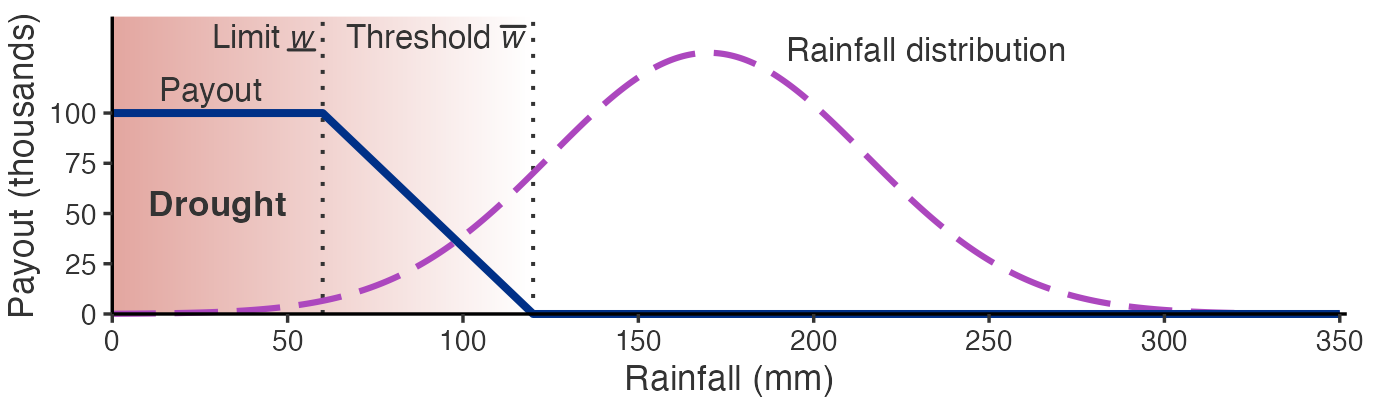
Index-Based Weather Insurance
Index-based weather insurance: easily verifiable and difficult to manipulate, avoiding AS and MH: \[\text{Payout}(w_t)=\begin{cases} M & w_t\le\underline{w} \\ M\cdot\frac{\overline{w}-w_t}{\overline{w}-\underline{w}} & \underline{w}<w_t<\overline{w} \\ 0 & w_t\ge\overline{w} \end{cases}\]
Limits to Index-Based Insurance
Limits to index-based insurance:
- How closely and simply weather tracks true crop losses
- How closely idiosyncratic weather tracks weather station
- Proper choices of thresholds, payouts, and premiums
- Trust and demand of farmers for product
- Uninsured idiosyncratic (“basis”) risk
- Incompleteness due to single weather phenomenon
What guards against AS and MH also introduces imperfection: product is based on an average
Impacts of Insurance
Impacts of insurance:
- Less need for asset or consumption smoothing (Janzen & Carter, 2019)
- Higher risk tolerance for higher-yield farming (Mobarak & Rosenzweig, 2014; Cai, 2016; Cole et al., 2014)
- Complementarities between informal risk sharing (basis risk) and formal index insurance (covariate risk) (Mobarak & Rosenzweig, 2013)
- Necessity of proper understanding, trust, and willingness for insurance to be taken up at optimal rates
Products must also be fairly priced and companies may need reinsurance against their own covariate shocks.
de Janvry & Sadoulet on Whether Index Insurance Works
The conclusion of this review of evidence is that, where available and affordable, index-based insurance does work for the intended purposes: it helps achieve more effective shock coping and less costly risk management. The outcome can be more growth and less poverty.
— de Janvry & Sadoulet, p. 345
Mobile Money
Mobile money has huge implications for efficiency:
- Change is not available and remittances are expensive
- Informal methods for transferring money are risky
- Improved risk sharing with easily accessible transactions
- Digital saving(?) and digital credit using phone data to overcome AS and MH to vet and monitor borrowers
de Janvry & Sadoulet on Digital Credit
Digital credit is very new. It provides an important development in financial inclusion, promising to reach the poor at a large scale. The current product is limited and raises many questions, but the sector will certainly expand its offer of services in the years to come. […] Mobile money and digital credit are promising avenues, allowing drastic reduction in cost and transaction costs in accessing financial services, but improvements are needed in products to fulfill poor people’s needs and in regulation to protect clients. In this sense, microfinance is an ongoing “revolution” with much creative thinking and entrepreneurship yet to happen. It is indeed an exciting and promising field for development economists to work in.
— de Janvry & Sadoulet, pp. 347–348
Saving
de Janvry & Sadoulet on Under-Saving
A well-known behavioral regularity across humanity is the tendency for people to under-save relative to what they themselves recognize to be best for them. This is due to procrastination (hyperbolic discounting), according to which we agree to save but only starting tomorrow, while we still enjoy high consumption today. Since tomorrow will be like today, the decision to save will be postponed forever (Rabin, 1998). A “sophisticated procrastinator,” who knows that he will postpone his decision again tomorrow, requires a commitment device or a nudge to help him save by overcoming time-inconsistent behavior (Thaler and Sunstein, 2008). There are fascinating institutional innovations that have emerged to offer disciplinary devices and nudges to willing savers, and they are being experimented with to verify their effectiveness (Karlan and Morduch, 2009).
— de Janvry & Sadoulet, p. 339
Behavioral Lessons for Saving
Behavioral lessons for saving:
- Sophistication1 of hyperbolic discounting2 agents
- Light-touch nudges (reminder, home visit, peer pressure)
- Binding commitment devices (at a price)
- Removal of temptation purchases
- Sensible default options
- Illiquid saving (piggy bank?)
Liquidity tradeoff between trust, access, and temptation.
de Janvry & Sadoulet on Earmarked Savings
Simply providing a safe place to keep money [in Dupas & Robinson, 2013] was sufficient to increase preventive health investment by 66 percent, and reduce vulnerability (not being able to meet an emergency need) by 25 percent, over the control. Enforcing the earmarking feature in the other two treatments had a contrasting effect: this rigidity increased savings for those whose objective was coping with emergencies, but reduced the investment for those that had a preventive goal, precisely because the rigidity prevents them from accessing their savings for emergencies. This shows the importance of maintaining escape options in the design of dedicated savings for investment to allow withdrawal for emergencies.
— de Janvry & Sadoulet, p. 340
Banerjee & Duflo on Saving and Expectations
Saving behavior crucially depends on what people expect will happen in the future. Poor people who feel that they will have opportunities to realize their aspirations will have strong reasons to cut down on their “frivolous” consumption and invest in that future. Those who feel that they have nothing to lose, by contrast, will tend to make decisions that reflect that desperation. This may explain not only the differences between rich and poor but also the differences among different poor people.
— Banerjee & Duflo, p. 215
Banerjee & Duflo on Hope as an Incentive
The bigger point is that a little bit of hope and some reassurance and comfort can be a powerful incentive. It is easy for those of us who have enough, living a secure life, structured by goals that we can reasonably confidently aspire to achieve […] and institutions designed to help us get there […] to assume, like the Victorians, that motivation and discipline are intrinsic. As a result, there are always worries about being overindulgent to the slothful poor. Our contention is that for the most part, the problem is the opposite: It is too hard to stay motivated when everything you want looks impossibly far away. Moving the goalposts closer may be just what the poor need to start running toward them.
— Banerjee & Duflo, p. 217
5-minute Break
Karlan, Osei, Osei-Akoto, & Udry (2014)
Randomly selected presenter: Sylvia
What is the research question?
How do the authors answer it?
What do they find?
Are you convinced by the design and results?
How does the paper connect to our other readings?
Group Discussion
Bringing together our lecture material and academic article, I have prepared the following suggested discussion questions:
How has the perspective on saving, credit, insurance, and microfinance changed over time in development economics?
What behavioral factors seem most relevant to raising the standard of living among the poor?
Did any saving or insurance product work better than you expected? Did any surprise you?
Roadmap
Looking Ahead to Week 11
What do we have on the horizon before next Tuesday?
My office hours for ECON 672 will be held Tuesday before class, 12:15-2:15pm in MCL 108 or virtually by appointment
Our eleventh topic will be Human capital: health and education. Our textbook reading will be Chapter 17. Our Poor Economics reading will be Chapters 3 and 4. Our required journal article will be Miguel & Kremer (2004), “Worms,” Econometrica.
Our Weekly Reading Response assignment for this paper will be due Tuesday at 2:40pm before class. One student will be randomly selected to present their response to the class in 5-8 minutes.
Footnotes
A sophisticated agent is aware of their own behavioral biases and anticipates them when making decisions, even if unable to overcome them. More technically, these agents use backward induction to predict how their future selves will act, which is why they value commitment devices.↩︎
Hyperbolic discounting refers to a behavioral bias where the discount rate falls with delay: we are far more impatient about waiting from today to tomorrow than about the same one-day wait a year from now. This makes preferences time-inconsistent, so a plan to start saving tomorrow is abandoned once tomorrow arrives.↩︎
Social Safety Nets
Social safety nets:
Tradeoff between risk coping and risk management similar to moral hazard: the better I can cope with risk, the less I may avoid it.