ECON 672: Economics of Development
Week 12: Labor markets and migration
de Janvry & Sadoulet on the Employment Problem
With generally rapid population growth and insufficient new jobs, developing countries are facing a huge employment problem. Because labor is the main asset that poor people have, creating opportunities for them to use this asset productively is the main instrument for poverty reduction. It is no surprise, then, that providing employment opportunities in remunerative activities, elevating the skill level of the labor force, and pacing migration between rural origins and urban destinations to avoid the expansion of urban slums are major development issues.
— de Janvry & Sadoulet, p. 301
Labor Market Dimensions
Labor market dimensions:
Size of informal vs. formal sector
Ease of hiring and firing workers
Amount of formal social assistance for the unemployed
Trade-offs between wages and social assistance for the employed
Disparities between “skilled” and “unskilled” workers
Cyclicality or countercyclicality with recessions
Result: very little open unemployment in developing countries; the problem is more underemployment than unemployment.
Unemployment versus Underemployment
The unemployment rate is the ratio of people without work to those in the labor force, but this figure can be deceiving. This includes only those who have actively looked for work recently or been temporarily laid off.
A low unemployment rate can hide:
“Discouraged workers” who have given up looking for work
Underemployment of those working but not full time
Underemployment of people working low-productivity jobs
Example: Colombia’s unemployment rate in the 1970s was just 5%, but total unemployment and underemployment was roughly 33%.
The Informal Labor Market
Statistics on the informal labor market:
61% of world employment (about 50% excluding agriculture)
86% in Africa
68% in Asia and the Pacific
69% in Arab states
40% in the Americas
de Janvry & Sadoulet on Informal Employment
Some 93 percent of world informal employment is in the developing countries, and 70 percent of informal sector workers are self-employed.
— de Janvry & Sadoulet, p. 302
Patterns of Migration
Migration:
Rural-rural, rural-urban mainly
Urban-rural in times of shocks (crisis, unemployment)
Seasonal, short-term, long-term, permanent
Push factors: home adversity
Pull factors: opportunity
Chief goal: remittances
Accompanies structural transformation we saw before
The Migration Decision
From our models, we would expect labor to chase higher marginal product and thus higher wage.
Thus, the migration decision should be driven by the expected wage differential between the rural and urban labor markets. However, we have also seen that beliefs can be incomplete or incorrect. Migrants may also face liquidity constraints, excessive (uninsured) risk, and a lack of information.
The accessibility of consumption in urban versus rural environments may also be a draw: not just how much money is earned but how easily it can be spent.
Evaluating Migration Constraints
Impact evaluation of migration constraints: pick a constraint, ease it for potential migrants, and see what happens to migration
Information asymmetry: provide (better) information on wages in the city
Excessive risk: offer an insurance product to reduce risk exposure for potential migrants
Liquidity constraint: offer a cash grant to offset migrating costs (Bryan et al., 2014; Lagakos et al., 2023)
Key outcome: changes in migration patterns
My Simple Model Sketch of Migration Decision
I migrate if the urban benefit \(B_u\), net of migration costs \(c\), exceeds the rural benefit \(B_r\) already in hand: \(B_u-c>B_r\).
Notice that \(B\) is not necessarily exclusively monetary: it could include access to public goods, quality of life, or other non-monetary benefits related to rural or urban life.
But urban benefit \(B_u\) is uncertain because I have not yet been to the city. Given my (possibly incorrect) beliefs, it instead has a distribution with mean \(E[B_u]=\mu^*_u\) and variance \(V[B_u]=\sigma^2_u\).
My Simple Model Sketch of Migration Decision, pt. 2
The certainty equivalent (CE) of an uncertain outcome is the sure amount that leaves me exactly as well off as the gamble (or indifferent between taking the gamble and the sure thing).
For the lottery \(L=(\$0,0.5;\$M,0.5)\)1, with expected value \(EV=\sum_xp(x)x=\frac12(0)+\frac12(M)=\frac12M\):
\(CE<EV\): I am risk averse (I pay a premium to avoid risk)
\(CE>EV\): I am risk loving (I pay a premium to take on risk)
\(CE=EV\): I am risk neutral (I do not care about risk)
We know most households to be (highly) risk averse2, so we would expect \(CE_u<\mu^*_u\).
My Simple Model Sketch of Migration Decision, pt. 3
If I am risk averse with coefficient \(\rho>0\), I value \(B_u\) at approximately \(CE_u=\mu^*_u-\frac{\rho}{2}\sigma^2_u\), so I migrate if and only if: \[\mu^*_u-\frac{\rho}{2}\sigma^2_u-c>B_r\]
Risk: \(\partial CE_u/\partial\sigma^2_u=-\rho/2<0\), so insurance (lower \(\sigma^2_u\)) encourages migration by raising \(CE_u\)
Liquidity: \(c\) is paid up front, so if I cannot borrow, I can migrate only if my cash on hand \(A\geq c\); a cash grant \(G\) of up to \(c\) encourages migration by letting \(A+G\geq c\)
Information: better information moves my belief \(\mu^*_u\) toward the true expected benefit \(\mu_u\) and encourages migration if \(\mu_u>\mu^*_u\) (I was underestimating the benefit of migration)
Simple Model of Migration: Harris-Todaro
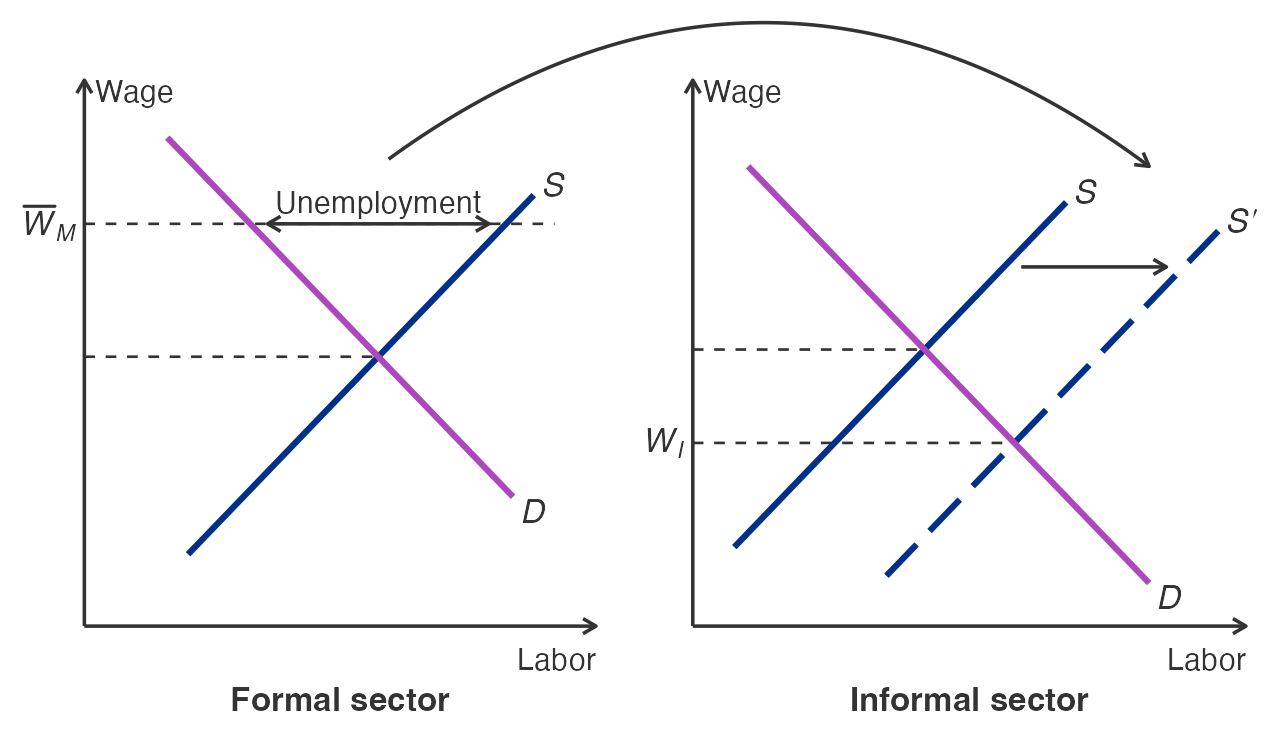
Current rural wage \(W_A\), formal-sector urban wage \(\overline{W}_M\), expected urban wage \(W^*_M\). \(P\) is probability of finding an urban job, urban employment rate; \(1-P\) is the urban unemployment rate.
Thus, \(W^*_M=P\overline{W}_M\) and migration happens if and only if: \[W^*_M=P\overline{W}_M>W_A\quad\text{or}\quad P>\frac{W_A}{\overline{W}_M}\] This implies that whenever (beliefs about) the urban employment rate \(P\) are higher than the wage ratio between rural and urban sectors, migration will occur (even if employment is not very likely, \(0<P\ll1\)). Even with just a 1:2 wage ratio, \(P>0.5\) will cause migration (despite a roughly 50% chance of unemployment)!
Policy Implications of Harris-Todaro
This model generates some thorny policy implications:
Increasing urban employment (without changing wages) will increase urban unemployment, since each new job draws in the reciprocal of the wage ratio: with a 1:4 wage ratio, migration continues until only 1 in 4 people find a job, so if we introduce 1 new job, we bring \((1/4)^{-1}=4\) new migrants and only 1 of them gets this job!
Closing the wage gap \(\overline{W}_M-W_A\) would mean either lowering formal wages (pull), often difficult due to union power and a high efficiency wage, or raising \(W_A\) (push), making rural agricultural work more profitable. However, this may also have the consequence of easing liquidity constraints on migration, meaning the overall effect is ambiguous (Bazzi, 2017).
Regulating urban migration overtly, e.g. China’s Hukou system
Linking Formal and Informal Wages
Banerjee & Duflo on Creating Good Jobs
How then can more “good jobs” be created? Clearly, it would help if it were easier to migrate to cities, so policies on urban land-use and low-income housing are obviously vital. Less obviously, effective social safety nets, consisting of both public assistance and market insurance, can make migration easier by reducing dependence on social networks. But because not everyone will be able to move to the city, it is also important that more good jobs be created not just in the largest cities but in smaller towns all over the country.
— Banerjee & Duflo, p. 249
Extensions of the Harris-Todaro Model
Extensions of the Harris-Todaro model:
Present discounted value (PDV) of migration over a long time horizon with migrant age and differential costs
Social networks increasing \(P\) or urban-resident bias decreasing \(P\). Migration networks and the employment benefits they offer can be stable and durable, e.g. Mexico to US.
Credit constraints and risk aversion may trap migrants who wish to migrate (and could improve their lives by doing so), also preventing them from accessing information on the benefits of migration. Do I migrate this year (with a subsidy) and then continue to do so after the subsidy goes away? (Bryan et al., 2014)
Urban returns to skill/education may also induce positive selection in who migrates, though advances in agricultural technology will decrease the urban skill premium
Migration as a Household Strategy
But…migrants are part of households driven by a desire to receive remittances: payments can offset local market failures (e.g. insurance or credit) for the household.
Credit-constrained household: remittances can stand in for a loan if the market fails to provide one
Risk-constrained household: remittances can stand in for insurance if the market fails to provide it
Motives for Remitting
Why remit? Motives may include:
Repayment to parents for rearing costs
Securing inheritance from parents
Providing social security to aging parents
Providing informal insurance during shocks
Altruism, preference for generosity
International Migration and Remittances
International migration and remittances:
258 million migrants in 2017
US$415 billion in remittance flows annually
Smaller than only FDI and private capital flows
Thirty countries derive more than 10% of GDP from remittances
Remittances largely spent on consumption and land investment (not productively invested in businesses)
Impacts of International Migration
Impacts of international migration:
Increased returns to education from larger employment opportunities abroad
Impacts on sending-household consumption and income from losing a worker: do remittances offset this?
Remittances (deposits) may provide liquidity to lenders to fund high-growth business projects
Positive externalities of migrant experience and knowledge upon return home
Positive externalities for non-migrants from reduced labor market competition
de Janvry & Sadoulet on Channeling Remittances
Given the extraordinary magnitude of remittance flows, it is no surprise that governments and development agencies are starting to experiment with ways of channeling remittances toward social infrastructure and local investments that can help create jobs and reduce poverty.
— de Janvry & Sadoulet, p. 320
Impacts of Migration on Receiving Countries
When absorbing large numbers of (international) migrants,
is there sufficient safe housing and infrastructure to welcome families? If not, young men may move on their own.
do migrants put downward pressure on “unskilled” wages for domestic workers?
can illegal migration be controlled with policy? Not well.
do migrants’ economic activities create a net positive or net negative effect on their local economy?
is there an increase in anti-immigrant sentiment or backlash in the domestic population?
de Janvry & Sadoulet on Managing Migration
Domestically, [migration] is the essence of structural transformation and internationally it is part of the globalization of a labor market. It can be an important force for development, with the potential for extensive benefits for both developing and industrialized countries. Remittances, in particular, create an extraordinary opportunity to finance development projects in some of the poorest emitting regions, if these regions have development potential and can channel the transfers toward productive investments. Yet migration is a difficult process to manage, both nationally and internationally, with a tendency for excessively rapid displacement of populations that are too often inadequately prepared to be absorbed productively in the receiving areas, and toward areas that are often not prepared to absorb them productively and culturally.
— de Janvry & Sadoulet, p. 322
5-minute Break
Lagakos, Mobarak, & Waugh (2023)
Randomly selected presenter: Justine
What is the research question?
How do the authors answer it?
What do they find?
Are you convinced by the design and results?
How does the paper connect to our other readings?
Group Discussion
Bringing together our lecture material and academic article, I have prepared the following suggested discussion questions:
What are some key push factors that lead to migration? What are some key pull factors?
How does migration fit into our earlier discussions of structural transformation, insurance, risk, and credit?
Should we think of “migration” as a single issue, or break migrants into categories? Which of these categories might be most important to consider?
Roadmap
Looking Ahead to Week 13
What do we have on the horizon before next Tuesday?
My office hours for ECON 672 will be held Tuesday before class, 12:15-2:15pm in MCL 108 or virtually by appointment
Our thirteenth topic will be Institutions, implementation, and political economy. Our textbook reading will be Chapter 20 and Chapter 21. Our Poor Economics reading will be Chapter 10. Our required journal article will be Olken (2007), “Monitoring Corruption: Evidence from a Field Experiment in Indonesia,” JPE.
Our Weekly Reading Response assignment for this paper will be due Tuesday at 2:40pm before class. One student will be randomly selected to present their response to the class in 5-8 minutes.