ECON 672: Economics of Development
Week 4: History of thought in development economics
Rodrik on Models and Remedies
If all these economists of the first rank have seen their ideas turn into practice, shouldn’t the problem of global poverty have been solved? Clearly, the world is still full of poor people, and the problem of underdevelopment remains one of the intractable challenges of the global economy…I think many of these paradoxes arise when applied economists and policy advisors mistake models and arguments that are valid only in specific circumstances for universal remedies…They should instead be diagnosticians, helping decisionmakers choose the right model (and remedy) for their specific realities, among many contending models (and remedies).
— Rodrik, 2010, pp. 34–35
Why the History of Thought Matters
The history of thought in development economics tells us why particular interpretations of underdevelopment were proposed and how they translated into policies that may still affect development outcomes today. The history of institutions and the history of thought are thus inextricably related: events shaped thought and thought shaped policy.
— de Janvry & Sadoulet, p. 83
Principles of Historical Analysis
Principles of history in development economics:
Development and underdevelopment are linked
Analysis includes both positive and normative components
From 1500 onward, we can arrange schools of thought into distinct major periods
Schools of thought differ on the relative importance they give to private markets, the state, and civil society
Major Periods, 1500–2019
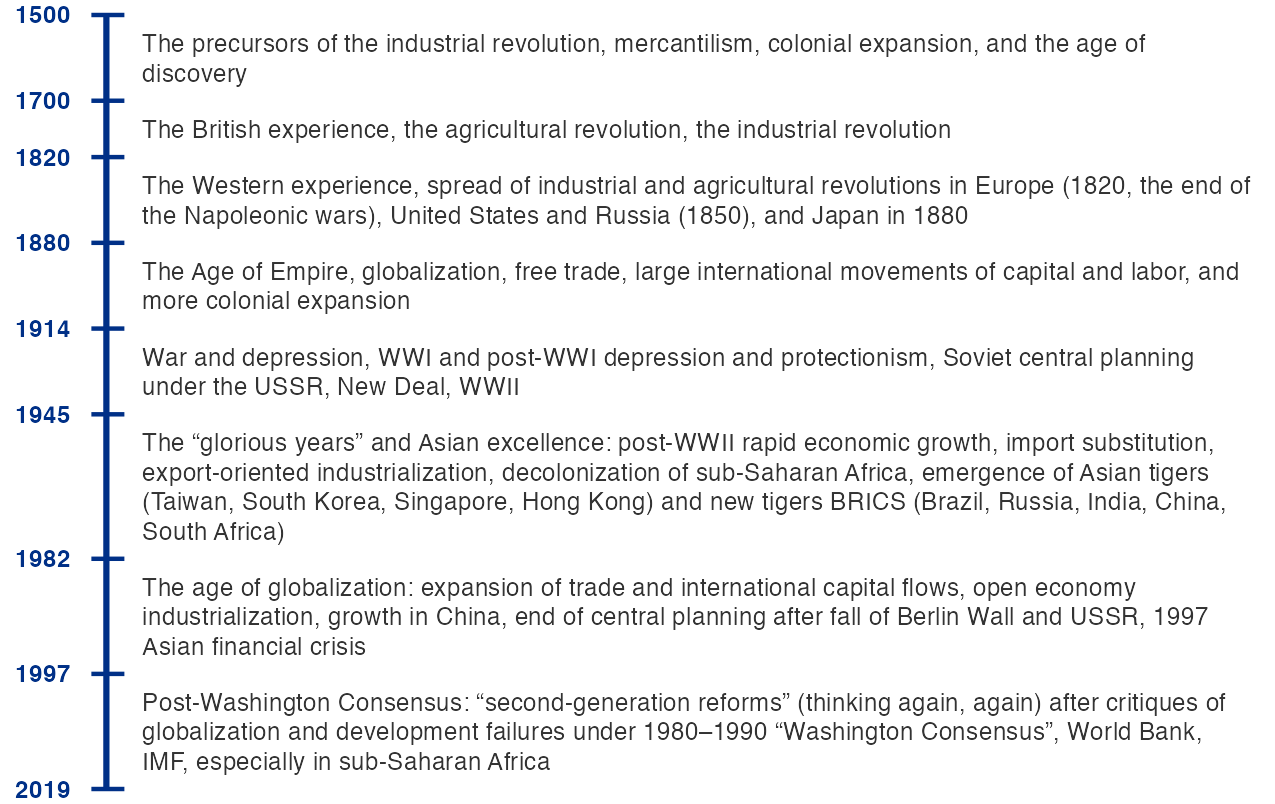
Mercantilism, 1500–1700
Mercantilism (1500–1700) focused on the accumulation of wealth through trade surpluses, colonial expansion, and state intervention in the economy.
Emergence of colonies of extraction vs. colonies of settlement on the basis of a country’s factor endowments, the institutions they left behind, and their impact on development (Sokoloff & Engerman, 2000; Acemoglu, Johnson, & Robinson, 2001; Nunn, 2008; Acemoglu & Robinson, 2012)
The British Experience, 1700–1820
British Experience (1700–1820) including Agricultural and Industrial Revolutions
Adam Smith, Wealth of Nations, the Invisible Hand, market coordination toward socially optimal outcomes, division of labor for productivity
Thomas Malthus, population growth, real incomes, and the Malthusian Trap1
David Ricardo, specialization in comparative advantage in (free) trade
The Intellectual Legacy of the British Experience
The intellectual legacy here is: (1) the role of the market and trade based on comparative advantage as the engine of development once competitiveness has been achieved, and (2) the role of inclusive economic institutions under the guidance of a centralized state, guaranteeing an appealing investment climate.
— de Janvry & Sadoulet, p. 89
“Trade based on comparative advantage…once competitiveness has been achieved” and “guaranteeing an appealing investment climate” — U.S. oil majors’ (lack of) Venezuelan investment after Maduro (New York Times The Daily, January 13, 2026)
The Western Experience: Be More Like Britain!
A key antecedent to the diffusion of the industrial revolution from Britain outward was the agricultural revolution, which often occurred “through the international migration of European farmers settling in colonies with broad expanses of land and favorable health conditions…As in the case of the agricultural revolution in Britain, gains in agricultural productivity allowed the freeing of labor for industry and the availability of low-priced food, keeping nominal wages in industry low” (de Janvry & Sadoulet, pp. 90–91).
Migration and agricultural technology transmission was broadly determined by local climates, with gains concentrated in temperate regions that still perform better today.
In this way, we see how climate impacted both early institutions (what kind of colony was set up) and agricultural progress (what they grew), both of which likely impact current development.
War and Depression, 1914–1945
World War I (WWI) and the Great Depression saw a sharp rise in state economic control across the West, as governments turned to emergency relief, public works, and direct management of production.
These ideas took power typically left to free markets (under classical theory) and gave it to the state in service of creating growth, covering basic needs, and reducing unemployment.
We see a prime example of this in the New Deal, a U.S. federal response to the Great Depression providing both transfers and direct employment to unemployed households to restart the economy.2
The Glorious Years, 1945–1982
During the “Glorious Years” of development, 1945–1982, development strategies turned inward. A principal concern was to generate sufficient demand to meet the supply of industrialization.
This was called the “big push” (Rosenstein-Rodan, 1943), a massive bulk investment in industry to achieve economies of scale and generate demand. The Harrod-Domar (1957), Lewis (1954), and Lele & Mellor (1981) models emerged from this “structuralist” approach.
Countries built up competitive domestic production through various means, including infant industry protection, government subsidies, import substitution, and export-oriented industrialization.
From Growth to Development, 1970–1982
For development economics, the central question thus became whether growth could be made more pro-poor. For the first time, it became evident that growth was necessary but not sufficient for poverty reduction; that growth could not be the only object for economic development; and that development had to be multidimensional, including poverty, inequality, and access to basic human needs in health and education.
— de Janvry & Sadoulet, p. 95
The Washington Consensus, 1982–1997
Mexico’s default in 1982 put an end to this “golden age of development economics” and ushered in a period that de-emphasized state intervention in favor of private markets.
Broadly called the “Washington Consensus” and endorsed by the IMF and World Bank, these reforms emphasized:
fiscal discipline
financial liberalization
trade liberalization
deregulation of FDI
privatization of public enterprises
While these policies saw success in restoring macroeconomic balance, their austerity came with huge costs to growth and development, often referred to as the “lost development decade”.
A Counter-Counterrevolution?
Krugman captured a turning of the tide in 1992, aruging much had been lost in the turn away from midcentury structuralist approaches and “counterrevolution” that led to the Washington Consesus:
What actually happened was that most developing countries were quite successful at developing industrial bases, but since these industries were highly inefficient, industrialization turned out not to have much to do with development. This called into question the whole idea that the problem of coordinating investments in the face of [externalities] was a major part of the underdevelopment story.
— Krugman, 1992, p. 28
The Post-Washington Consensus, 1997–2019
The post-Washington Consensus period “reset the focus of development on its multidimensionality: not only restoring growth following the debt crisis and difficult transitions out of central planning, but also reducing poverty and inequality, delivering basic needs, addressing vulnerability to shocks, and, importantly, achieving a more sustainable use of natural resources…There was also greater recognition that one approach will not work everywhere—as opposed to simply ‘getting the prices right’ under the Washington Consensus—because initial conditions are so different across countries” (de Janvry & Sadoulet, p. 98).
Elements of the Post-Washington Consensus
Some elements of this post-Washington Consensus are:
endogenous growth (e.g. Romer’s model)
open economy industrialization (e.g. attracting foreign investment)
institutional innovations (e.g. help markets work better and provide alternatives when they fail)
community-driven development and public reforms
sustainability and sustainable growth
impact evaluation to learn about causality (Next week!)
agriculture for development
The 2019 Nobel Prize in Economics

Coverage of Banerjee & Duflo
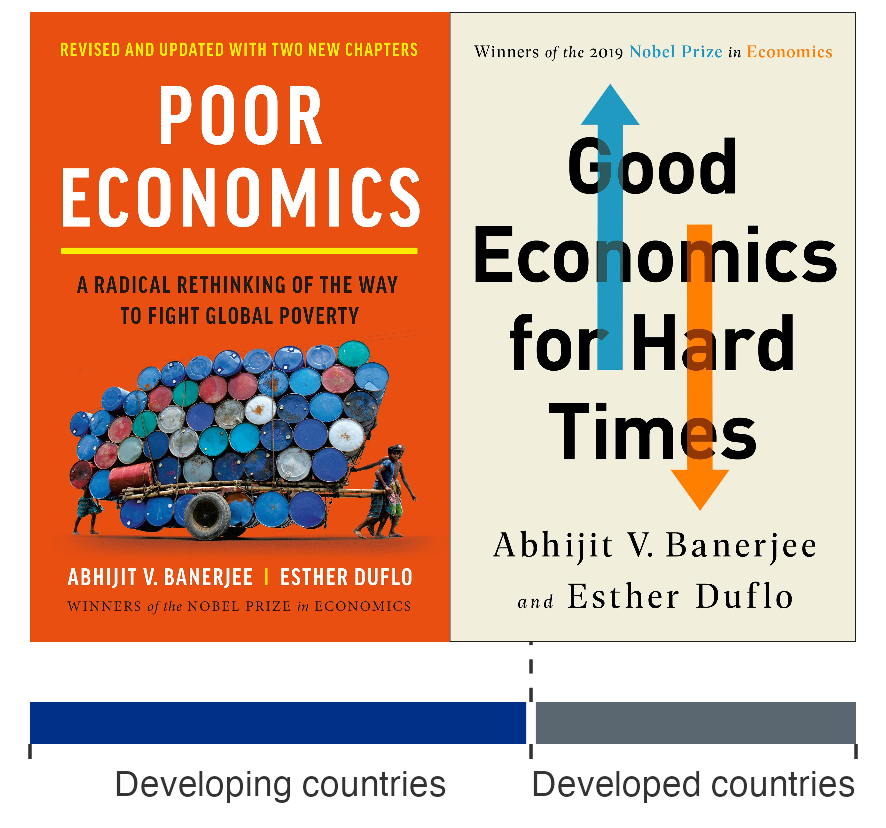
Banerjee & Duflo on Understanding the Poor
The field of anti-poverty policy is littered with the detritus of instant miracles that proved less than miraculous. To progress, we have to abandon the habit of reducing the poor to cartoon characters and take the time to really understand their lives, in all their complexity and richness.
— Banerjee & Duflo, 2025, p. liii
Rodrik on Diagnostics and Experimentation
Successful countries are those that have implemented these two steps in an ongoing manner: identify sequentially the most binding constraints and remove them with locally suited remedies. Diagnostics requires pragmatism and eclecticism, in the use of both theory and evidence. It has no room for dogmatism, imported blueprints, or empirical purism…The experimentalist approach…starts with relative agnosticism on what works and what doesn’t.
— Rodrik, 2010, pp. 37, 41
5-minute Break
Rodrik (2010)
Randomly selected presenter: Julia
What is the research question?
How do the authors answer it?
What do they find?
Are you convinced by the design and results?
How does the paper connect to our other readings?
Group Discussion
Bringing together our lecture material and academic article, I have prepared the following suggested discussion questions:
We have emphasized the importance of context-specific investigation and policy design. Where might such localized solutions be most necessary or effective?
So far we have considered macro-level growth and development policy, but will now turn to more micro-level evaluation. How might each contribute to our understanding?
In 2025, the Trump administration shuttered the U.S. Agency for International Development (USAID), cutting U.S. official development assistance by 57%3 and redirecting what survived toward an “America First” foreign assistance agenda. How might various economic perspectives respond to this action?
Roadmap
Looking Ahead to Week 5
What do we have on the horizon before next Tuesday?
Our Revised Topic Proposals assignment will be due on Friday at 6pm
My office hours for ECON 672 will be held Tuesday before class, 12:15-2:15pm in MCL 108 or virtually by appointment
Our fifth topic will be Impact evaluation: methods and their critics. Our textbook reading will be Chapter 4. Our Poor Economics reading will be the Preface and In Place of a Sweeping Conclusion. Our required journal article will be Deaton (2010), “Instruments, Randomization, and Learning about Development,” JEL.
Our Weekly Reading Response assignment for this paper will be due Tuesday at 2:40pm before class. One student will be randomly selected to present their response to the class.
Footnotes
Malthusian Trap: land is fixed, so labor faces diminishing returns. Income above subsistence raises population until income is driven back down, so technological progress yields a larger population rather than a higher living standard. Ashraf & Galor (2011), “Dynamics and Stagnation in the Malthusian Epoch,” AER, find that over 1–1500 CE technological superiority and land productivity raised population density but not living standards.↩︎
John Maynard Keynes’s General Theory of Employment, Interest and Money (1936), which emphasized aggregate demand and an increased role for the state, appeared three years after the New Deal began.↩︎
OECD preliminary data, April 2026: U.S. ODA fell to $29 billion in 2025, driving a record 23.1% decline in global aid.↩︎