ECON 672: Economics of Development
Week 8: Financial services for the poor
de Janvry & Sadoulet on Financial Tools
Low-income households need effective financial tools, as does anyone else, to help them seize business opportunities, improve their homes, deal with other large expenses, and cope with emergencies. Yet many of the financial services they can access are costly, unsafe, or not well suited to their needs.
— de Janvry & Sadoulet, p. 326
Moving Money Between Periods
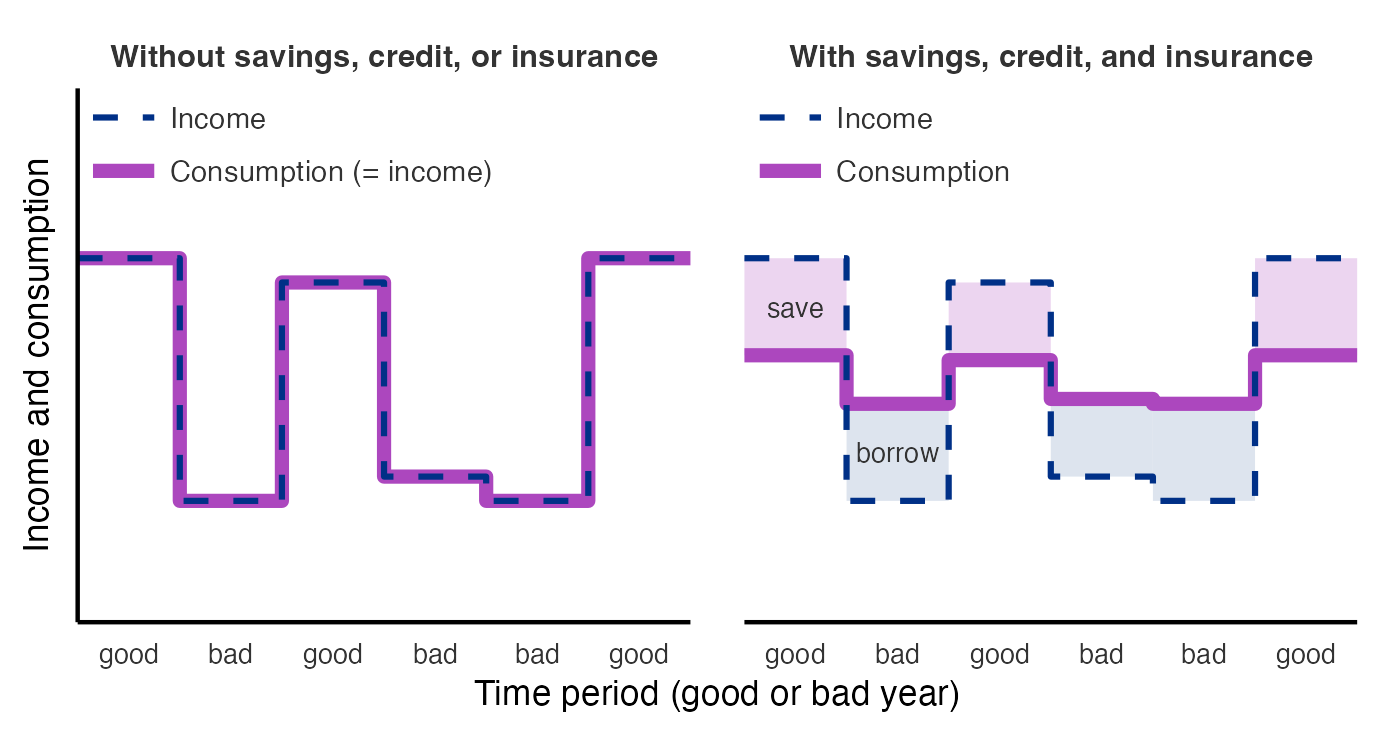
Financial instruments move money between periods:
lumpy purchases (e.g. livestock, a metal roof, school fees, or a wedding)
lumpy income (e.g. a harvest sold once or twice a year, or earnings from seasonal migration)
consumption smoothing
credit and savings as insurance
Consumption Smoothing
The Generic Lender Problem
Generic lender problem: asymmetric information, adverse selection, and moral hazard
Asymmetric information (AI) means borrowers know more about their own riskiness than lenders do
Adverse selection (AS) means risky borrowers (“hidden type”) are more likely to seek loans or insurance
Moral hazard (MH) means borrowers may take opportunistic “hidden actions” that the lender cannot prevent once the loan is made
Together, these (1) raise the cost of borrowing for all and (2) reduce the size of the market.
Why Lenders Exclude the Poor
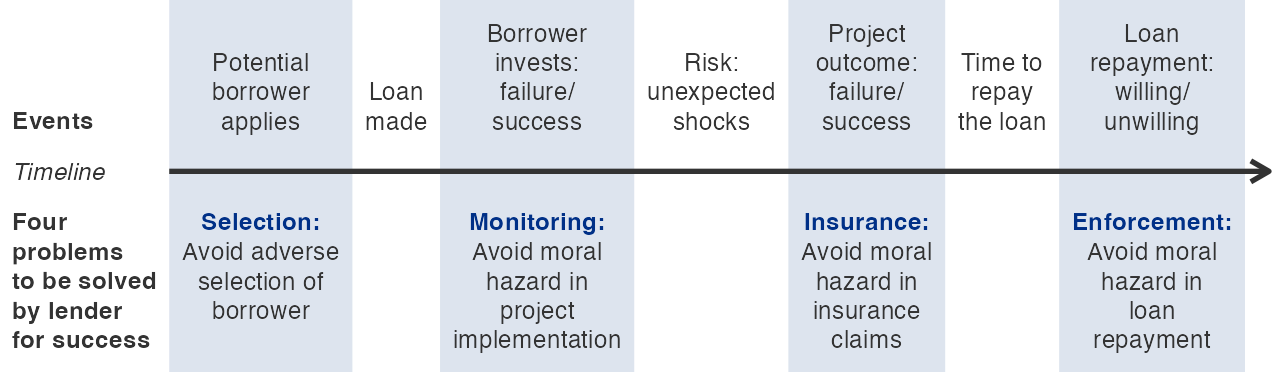
Why exclude the poor from borrowing?
Screening problem: who is a high-quality borrower?
Monitoring problem: what does the borrower do with the money?
Insurance problem: provide leniency for bad shocks while avoiding opportunism
Enforcement problem: ensure borrowers are willing and able to repay
In environments with strongly asymmetric information and weak enforcement of laws, the optimal response of lenders may be to exclude poor borrowers altogether.
Four Problems for the Lender
Banerjee & Duflo on Who Lends to the Poor
Because the main constraint on lending to the poor is the cost of gathering information about them, it makes sense that they would mostly borrow from people who already know them, such as their neighbors, their employers, the people they trade with, or one of the local moneylenders, and that is exactly what happens.
— Banerjee & Duflo, p. 176
Collateral and Commercial Banks
Commercial banks require collateral to lend, which the poor often do not have or cannot afford to pledge (e.g. house):
Efficiency loss: good projects are not funded and the market is too small
Equity loss: sharp inequalities against potential borrowers mean poverty reproduces poverty
The result is that the poor often must secure insurance to gain access to formal borrowing, and so most cannot borrow this way (Banerjee & Duflo, 2011).
Local Moneylenders
Local moneylenders are informal agents with local knowledge (symmetric information, SI) to solve AS and MH and more flexibility in collateral than formal banks.
However, these lenders also typically charge extremely high (usurious) rates for their lending, due to market power, liquidity needs, and frequent capital idleness.
Moneylenders may be a suitable, if expensive, solution to idiosyncratic shocks but cannot deal with covariate shocks to entire communities. Here we see a tradeoff between local SI and portfolio risk diversification.
Interlinked Transactions
Another solution to local credit may involve interlinkages: multi-step transactions that involve both a loan and other productive economic activity
credit with a subsequent purchase agreement
credit and preferential access to productive capital
credit and insurance to prevent devastating loss from shock
In this way, the linked transaction can act as a form of collateral: failing to repay a loan means losing out on this beneficial resource.
Rotating Savings and Credit Associations
ROSCAs (Rotating Savings and Credit Associations) are informal groups that provide lump sum cash to a rotating recipient member.
These exist in many communities among members with a high level of trust, regular meetings, and equal per-period deposit amount that is pooled and delivered to one member each meeting.
This trust structure addresses AS and MH, with social capital and community knowledge standing in for formal collateral.
Due to their ability to make smooth income streams lumpy, ROSCAs may provide a way to avoid temptation spending and meet longer-term savings targets (“tying your hands”) or for female members to shield assets from spousal capture.
Village Banks and Self-Help Groups
Village banks and self-help groups sit between the informal ROSCAs and formal commercial banks. Village banks may involve hundreds of members and formal by-laws.
Proximity lending solves the AI, AS, and MH problems, but securing deposits in a weakly regulated context may be challenging. The tradeoff of mismanagement (too little regulation) and rigidity (too much regulation) means village banks are often difficult to mobilize. Growth might also be hindered, as increasing size may increase AI and thus AS and MH.
Self-help groups, usually composed of small numbers of local women, also pool financial resources to then lend out to members or others in the community, establishing a positive credit history and trust to gain access to commercial bank loans.
Microfinance Institutions
MFIs (MicroFinance Institutions) also replace physical collateral with social collateral, lending to a small group of self-policing members rather than an individual. Championed in Bangladesh by economist (and 2006 Nobel Peace Prize winner) Muhammad Yunus, this model has been copied in many countries around the world.
These groups also attempt to solve the AI, AS, and MH problems by putting the entire group on the hook for missed payments, bad behavior, and access to future lending. These groups often also require frequent (weekly or biweekly) payments, meaning they may also provide disciplinary saving enforcement for borrowers (“borrowing to save”).
While cheaper than moneylenders, MFIs are often still quite expensive and not well suited to longer-cycle, higher-risk economic activities (e.g. agriculture). There is also the risk of positive selection: the most credit-worthy members may defect and take out (less risky) individual loans rather than remain in the group.
Features of Microfinance Lending
MFI features:
group lending
joint liability
self-selection into small groups (5-30)
frequent payment installments
dynamic (growing) incentives to reward repayment
These produce assortative matching, peer monitoring, mutual insurance, and interlinkages built on social capital for members, solving AS and MH.
Ongoing Issues in Microfinance
Ongoing issues in MFI lending:
profit drive may induce larger loan sizes and increase default risk (“mission drift”)
organizations run by NGOs may be seen as charities rather than businesses, which may reduce repayment incentives
market power is required to allow MFIs to reward repayment with larger loans
MFIs need access to a steady stream of capital (not just seed donations) to grow and meet demand
MFI growth may mean organizations overlap and must compete for borrowers, raising risk exposure for borrowers with multiple loans
Banerjee & Duflo on Microcredit and Risk Taking
[…] microcredit may not even be an effective way to discover entrepreneurs who will then go on to set up large businesses. Microfinance gives its clients every incentive to play it safe, so it is not well suited to discover who has an appetite for risk taking.
— Banerjee & Duflo, p. 190
Tradeoffs in Financial Services for the Poor
Common tradeoffs in financial services for the poor:
size-information (as I grow, I know my members less well)
management-regulation (self-governance is more flexible but also more vulnerable)
size-diversification (local organizations cannot insure against covariate shocks)
de Janvry & Sadoulet on Microfinance Impacts
[…] results indicate that the jury is still out on a final verdict on the role of microfinance for development. There is considerable heterogeneity across potential users and many more experiments and impact evaluation studies will be needed before we can conclude. Early results show that positive income effects cannot be assumed simply because loans are taken and repaid. Quick results on poverty reduction are generally elusive and conditional on additional assistance to the poor beyond access to a loan.
— de Janvry & Sadoulet, p. 338
Banerjee et al. (2015) on Microcredit
In short, microcredit is not for every household, or even most households, and it does not lead to the miraculous social transformation some proponents have claimed. Its principal impact seems to be, perhaps unsurprisingly, that it allows some households to sacrifice some instantaneous utility (temptation goods or leisure) in order to finance lumpy purchases, either for their home or in order to establish or expand a business.
— Banerjee et al., 2015, pp. 25–26
Banerjee & Duflo (2025) on Microcredit
With the benefit of fifteen years’ hindsight, it’s likely that we were too pessimistic about the ability of microcredit to help grow businesses […] And indeed, the results from the various RCTs on microfinance around the world showed a dramatic difference between preexisting businesses and the rest. A finding common to all experiments is that the effect on profits is positive for those who already ran a business before access to microfinance was made available to them. However, the benefits were small or nonexistent for the majority of businesses, even those preexisting ones. Only the most successful entrepreneurs seem to account for most of the gains. Microcredit does lead to very substantial income growth for some—but they are a small minority.
— Banerjee & Duflo, pp. xxxiv–xxxv
5-minute Break
Banerjee, Duflo, Glennerster, & Kinnan (2015)
Randomly selected presenter: Kindra
What is the research question?
How do the authors answer it?
What do they find?
Are you convinced by the design and results?
How does the paper connect to our other readings?
Group Discussion
Bringing together our lecture material and academic article, I have prepared the following suggested discussion questions:
What are the central challenges of lending to the poor? Are these unique to this population? Why do these increase borrowing costs and barriers so significantly?
What does the “borrowing to save” feature of ROSCAs, MFIs, and other credit vehicles targeted to the poor imply about the rationality of borrowers?
Many impact evaluations have now been done on MFIs and other lending programs to the poor, but what should it mean for a program to be successful? What are some of the main tensions and challenges that have arisen as these programs are scaled up?
Roadmap
Looking Ahead to Fall Break
What do we have on the horizon before we meet again?
Our Identifying Data Source(s) assignment will be due on Friday at 6pm to identify prospective data for the final project
Next Tuesday is fall break: we have no lecture or office hours
The following Tuesday we resume in week 10. Our tenth topic will be Risk, insurance, and savings. Our textbook reading will be Chapter 13, pp. 338-350 and Chapter 10, pp. 266-272. Our Poor Economics reading will be Chapters 6 and 8. Our required journal article will be Karlan, Osei, Osei-Akoto, & Udry (2014), “Agricultural Decisions after Relaxing Credit and Risk Constraints,” QJE.
Our Weekly Reading Response assignment for this paper will be due at 2:40pm before that class. One student will be randomly selected to present their response to the class.